


When I started my marketing career back in 2009, ABM wasn’t even in my vocabulary. Now, after implementing Account-Based Marketing programs for over a dozen enterprise organizations, I’ve learned that traditional ABM alone just doesn’t cut it anymore. Trust me, I’ve been there – pouring resources into targeted campaigns only to watch deals stall because sales and customer success weren’t aligned with marketing efforts.
Last year, while overhauling the go-to-market strategy for a mid-sized SaaS company, I had my lightbulb moment. We weren’t failing at ABM – we were succeeding at only one part of what should have been a comprehensive Account-Based Experience Orchestration Strategy.
Why Traditional ABM Falls Short (And What I Learned the Hard Way)
Remember when ABM was the hot new thing? I certainly do. Back in 2017, I convinced my CMO to invest a significant portion of our budget into an ABM platform, promising it would transform our pipeline. The initial results looked promising – engagement from target accounts increased by 47%. But then…nothing. Conversion rates barely budged.
What went wrong? Well, everything beyond that initial engagement.
Our sales team wasn’t prepared to continue the conversation marketing had started. Customer success had no visibility into the specific pain points that had attracted prospects in the first place. And product marketing? They were creating content for personas that didn’t align with our ABM targets.
God, I hate when companies treat ABM as just a marketing tactic rather than a business strategy. This siloed approach creates disjointed experiences that sophisticated B2B buyers can smell from a mile away.
The solution isn’t abandoning ABM – it’s evolving to an Account-Based Experience Orchestration Strategy that aligns every customer-facing function around a unified approach to key accounts.
What Exactly Is Account-Based Experience Orchestration Strategy? Here
Account-Based Experience Orchestration Strategy takes the targeting precision of ABM and extends it across the entire customer journey. It’s about creating cohesive experiences, not just campaigns.
Think of traditional ABM as playing a single instrument really well. An Account-Based Experience Orchestration Strategy is conducting an entire orchestra – ensuring sales, marketing, product, and customer success are all playing the same symphony.
The core components of an effective Account-Based Experience Orchestration Strategy include:
- Unified account intelligence – A single source of truth for account data, accessible to all revenue teams
- Cross-functional ABM experience alignment – Ensuring consistent messaging and handoffs between departments
- Experience-focused metrics – Moving beyond marketing-only measurements to track the entire account journey
- Technology integration – Connected systems that prevent experience fragmentation
- Revenue team ABM collaboration framework – Formal structures for cross-functional planning and execution
When implemented correctly, this approach transforms how target accounts experience your brand from first touch to renewal and beyond.
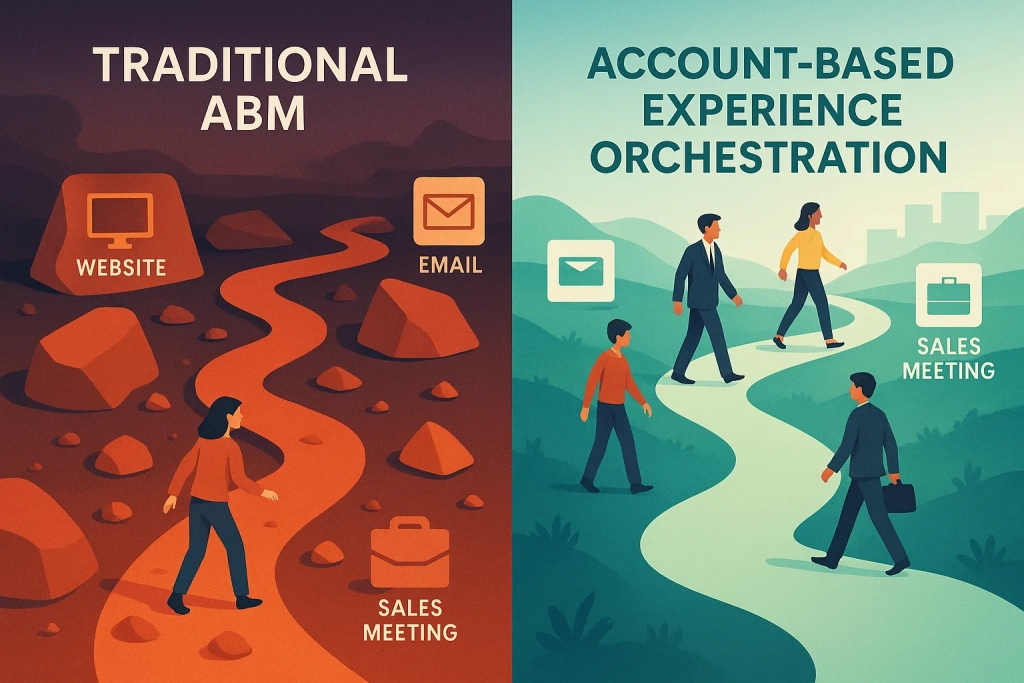
The Evolution from ABM to Experience Orchestration
I remember sitting in a quarterly business review in 2019, presenting what I thought were impressive ABM metrics – engagement up 60%, MQLs from target accounts increased by 35%. My CEO wasn’t impressed.
“But are we closing more deals?” he asked.
Ouch. The answer was not really. And that’s when I realized the fundamental limitation of traditional ABM.
Here’s how the progression typically works:
Stage 1: Basic ABM
Most companies start here – marketing identifies target accounts and creates specialized content and campaigns. Sales may or may not be fully aligned. This is what we implemented back in 2019, and while it increased engagement, it didn’t move the revenue needle significantly.
Stage 2: ABM Coordination
At this stage, marketing and sales align on target accounts and coordinate outreach. This is where many companies plateau – they’re doing “better ABM” but still treating it as a campaign approach rather than a customer experience strategy.
Stage 3: Account-Based Experience Orchestration Strategy
This is the mature stage where marketing, sales, product, and customer success unite around a shared understanding of target accounts. The focus shifts from campaigns to orchestrating consistent experiences across the entire customer journey.
In my experience working with dozens of B2B organizations, less than 15% have truly reached Stage 3. The majority are stuck in Stage 2, wondering why their ABM investments aren’t delivering the expected returns.
How Do You Build a Unified Customer Journey Map for ABM?
One of the foundational elements of Account-Based Experience Orchestration Strategy is unified customer journey mapping for ABM. This isn’t your standard journey map – it needs to reflect the complexity of B2B buying committees and account-level engagement.
Last summer, I worked with a cybersecurity client to develop their journey mapping approach. Here’s the process we used, which you can adapt for your organization:
- Identify all touchpoints across functions – Document every potential interaction your target accounts might have with your company, from marketing emails to support tickets.
- Map buying committee roles to journey stages – Different stakeholders engage at different points, so your journey map should reflect this complexity.
- Document current handoff processes – How does information about an account transfer between teams? These transition points are where most experience breakdowns occur.
- Identify experience gaps and inconsistencies – Look for places where messaging becomes inconsistent or where accounts receive conflicting information.
- Create an ideal-state journey – Design what the perfect account experience would look like if all systems and teams were perfectly aligned.
- Develop experience orchestration playbooks – Create detailed plans for how teams should collaborate at each journey stage.
The key insight from our journey mapping exercise? The biggest gaps weren’t in any single department’s approach – they were in the handoffs between teams. For instance, we discovered that sales was completely unaware of which specific resources prospects had engaged with before becoming opportunities.
Implementing Cross-Functional ABM Experience Alignment
In theory, everyone agrees that alignment is important. In practice? It’s damn hard to achieve. Based on my work implementing Account-Based Experience Orchestration Strategy across various organizations, here are the critical components:
1. Shared Account Prioritization Model
One of my clients had a situation where marketing was targeting mid-market healthcare companies while sales was focused on enterprise financial services. Talk about misalignment!
Effective Account-Based Experience Orchestration Strategy requires all teams to agree on:
- Which accounts to target
- Why those accounts matter
- What success looks like for each account
I recommend creating a simple tier system (Tier 1, 2, and 3) with clear criteria for each level and corresponding service levels. This creates clarity about where to invest your orchestration efforts.
2. Unified Account Intelligence Hub
You can’t orchestrate experiences without shared data. Period.
This doesn’t necessarily mean investing in expensive new systems. For a midsize manufacturing client, we actually built their intelligence hub using existing tools – Salesforce as the foundation, supplemented with intent data and engagement scoring.
The key is ensuring all teams can access and contribute to account intelligence. Marketing should see sales activities, sales should see support tickets, and everyone should understand the account’s overall health and engagement.
3. Revenue Team ABM Collaboration Framework
Informal collaboration isn’t enough for true Account-Based Experience Orchestration Strategy. You need structured processes for how teams work together.
At minimum, establish:
- Weekly cross-functional account reviews for top-tier targets
- Shared planning sessions for account-specific campaigns
- Clear ownership of experience orchestration (this could be a dedicated role or a rotating responsibility)
- Regular evaluation of the end-to-end account experience
In my consulting work, I’ve found that organizations with formal collaboration frameworks achieve ABM ROI nearly 3x higher than those relying on ad-hoc coordination.
Technology Requirements for Experience Orchestration
I’m not a tech evangelist by any stretch. In fact, I’ve seen too many companies throw money at ABM platforms expecting them to solve strategic alignment problems. That doesn’t work.
However, certain technologies do enable effective Account-Based Experience Orchestration Strategy:
Core Technology Components:
- CRM with robust account management – The foundation of your orchestration efforts
- Account engagement tracking – Monitoring interactions across marketing, sales, and service
- Unified customer data platform – Bringing together account intelligence from multiple sources
- Communication orchestration tools – Coordinating outreach across channels and teams
- Analytics that span the full customer lifecycle – Measuring the end-to-end account experience
The specific vendors matter less than how these tools connect. In fact, one of my most successful clients built their Account-Based Experience Orchestration Strategy using primarily their existing martech stack – they just integrated the tools more effectively.
The biggest technological barrier I typically see is disconnected systems that create data silos. When marketing can’t see sales activities, or customer success has no visibility into marketing engagement, orchestrating a cohesive experience becomes virtually impossible.
Case Study: From Fragmented ABM to Experience Orchestration
Let me share a real-world example from a client I worked with in 2023 – a B2B software company selling enterprise resource planning solutions. For privacy reasons, I’ve changed some details, but the story and results are authentic.
The Starting Point
The company had invested heavily in ABM technology but struggled with:
- 6-month sales cycles that frequently stalled mid-funnel
- Target accounts receiving disconnected communications from multiple teams
- Poor conversion from marketing engagement to sales opportunities
- Customer success having no visibility into the promises made during the sales process
Typical ABM challenges, right? Their fundamental problem wasn’t poor targeting or weak content – it was the lack of an Account-Based Experience Orchestration Strategy.
The Transformation
We implemented a phased approach to build their Account-Based Experience Orchestration Strategy:
Phase 1: Foundation
- Established a cross-functional ABM governance team with representatives from marketing, sales, product, and customer success
- Created a unified account scoring model incorporating fit, intent, and engagement metrics
- Documented the current and ideal account journey across all touchpoints
Phase 2: Process Alignment
- Developed handoff protocols between teams to maintain experience continuity
- Implemented weekly “top accounts” reviews with all customer-facing teams
- Created account dossiers accessible to anyone interacting with target organizations
Phase 3: Technology Integration
- Connected their marketing automation, CRM, and customer success platforms
- Built custom dashboards showing the full account journey
- Implemented shared account planning tools
Phase 4: Measurement Evolution
- Shifted from function-specific metrics to account experience metrics
- Established regular experience audits from the customer perspective
- Created feedback loops to continuously improve orchestration
The Results
Within six months of implementing their Account-Based Experience Orchestration Strategy, the company saw:
- 27% reduction in sales cycle length
- 42% increase in average deal size
- 38% improvement in target account conversion rates
- 19% boost in expansion revenue from existing customers
The most telling metric? A 67% increase in positive feedback specifically mentioning the cohesive experience across teams.
Common Pitfalls in Account-Based Experience Orchestration Strategy Implementation
I’ve seen some spectacular failures when organizations attempt to move toward Account-Based Experience Orchestration Strategy. Learn from their mistakes:
Pitfall 1: Treating It as a Marketing-Only Initiative
In one memorable instance, a marketing VP launched what he called an “experience orchestration initiative” without involving sales or customer success in the planning. Three months and $150,000 later, nothing had changed in terms of account experiences or business results.
Solution: Establish cross-functional ownership from day one. This isn’t a marketing project – it’s a business transformation.
Pitfall 2: Expecting Technology to Solve Alignment Problems
A financial services firm I consulted with had invested in every ABM technology imaginable but still struggled with experience fragmentation. Why? Their organizational silos were reinforced by compensation structures and departmental goals that encouraged conflicting behaviors.
Solution: Address the organizational and incentive issues first, then determine what technology can enhance your aligned approach.
Pitfall 3: Failing to Map the Entire Account Journey
Many companies focus intensely on the pre-purchase journey but neglect the implementation and expansion phases. One technology company I worked with was generating impressive engagement with target accounts but saw 30% of their new customers churn within a year because the post-sale experience felt disconnected from what was promised.
Solution: Map and orchestrate the complete account lifecycle, from first touch to renewal and advocacy.
Pitfall 4: Not Building for Scale
I once watched a company launch a beautiful Account-Based Experience Orchestration Strategy for their top 10 accounts. The results were impressive, but the approach required so much manual coordination that they couldn’t expand beyond that initial set of targets.
Solution: Design your orchestration processes to scale from the beginning, with clear guidelines for different account tiers and appropriate resource allocation.
How to Get Started with Your Account-Based Experience Orchestration Strategy
If you’re convinced it’s time to move beyond basic ABM (and you should be), here’s a practical roadmap to begin your journey:
Step 1: Assess Your Current State
Before diving into implementation, evaluate where you stand today:
- How aligned are your customer-facing teams around target accounts?
- What does your current account handoff process look like?
- Where do prospects and customers experience inconsistency?
- What data can already be shared across functions?
This assessment will reveal your biggest experience gaps and orchestration opportunities.
Step 2: Secure Cross-Functional Buy-In
Account-Based Experience Orchestration Strategy requires commitment from multiple teams. Schedule dedicated workshops with marketing, sales, customer success, and product leaders to:
- Share the vision for orchestrated account experiences
- Identify the specific benefits for each function
- Address concerns and resistance points
- Establish shared goals and success metrics
In my experience, getting genuine buy-in at this stage is critical. Without it, you’ll end up with superficial cooperation rather than true collaboration.
Step 3: Start with a Pilot Program
Don’t boil the ocean. Select 5-10 target accounts for your initial Account-Based Experience Orchestration Strategy pilot. This allows you to:
- Test and refine your orchestration processes
- Demonstrate value before scaling
- Identify unforeseen challenges in a controlled environment
- Build internal case studies to drive broader adoption
For my manufacturing client, we started with just their top 5 accounts. The impressive results from this small pilot created overwhelming demand from sales leaders who wanted their accounts included in the program.
Step 4: Build Your Orchestration Playbook
Document exactly how your teams will collaborate to deliver cohesive account experiences:
- Who is responsible for each stage of the account journey
- How and when handoffs occur between functions
- What account information must be maintained and shared
- Which metrics will track orchestration effectiveness
- How to handle common scenarios and exceptions
This playbook becomes your blueprint for scaling Account-Based Experience Orchestration Strategy across your organization.
The Future of Account-Based Experience Orchestration Strategy
As I look ahead to where B2B go-to-market strategies are evolving, several trends are shaping the future of Account-Based Experience Orchestration Strategy:
1. AI-Enhanced Orchestration
Machine learning is already helping identify optimal next actions for target accounts based on behavioral patterns. Soon, AI will automate much of the cross-function coordination, recommending when and how different teams should engage with accounts based on their specific journey stage and needs.
2. Deeper Personalization at Scale
The balance between personalization and scale has always been challenging. Advanced orchestration platforms are beginning to enable truly personalized experiences that still operate efficiently across larger account sets.
3. Unified Customer Journey Management
I’m seeing forward-thinking companies establish dedicated “journey orchestration” roles that span traditional departmental boundaries. These orchestrators ensure consistent experiences regardless of which team is currently “owning” the account relationship.
4. Experience-Based Differentiation
In increasingly commoditized markets, the experience you provide is becoming as important as your product features. Companies with mature Account-Based Experience Orchestration Strategy capabilities will win deals even against competitors with superior product offerings.
Conclusion: The Competitive Necessity of Experience Orchestration
Looking back on my 15+ years in B2B marketing, the shift from traditional demand generation to ABM was revolutionary. The evolution from ABM to Account-Based Experience Orchestration Strategy represents an equally important transformation.
In today’s complex buying environment, delivering fragmented experiences to your most valuable accounts isn’t just a missed opportunity – it’s a competitive liability. The organizations that master Account-Based Experience Orchestration Strategy will create the kind of seamless, value-driven experiences that modern B2B buyers expect.
My advice? Don’t wait for perfect conditions to begin this journey. Start now with whatever resources you have, focusing first on alignment and orchestration for your most valuable accounts. The technology and scale will follow as you demonstrate success.
Remember: your customers don’t care about your organizational structure or system limitations. They experience your brand as a single entity and expect coherence across every interaction. Account-Based Experience Orchestration Strategy is how you deliver on that expectation.
I’d love to hear about your experiences implementing Account-Based Experience Orchestration Strategy or the challenges you’re facing as you evolve your ABM approach. Connect with me on LinkedIn to continue the conversation!
Frequently Asked Questions About Account-Based Experience Orchestration Strategy
1. How is Account-Based Experience Orchestration Strategy different from traditional ABM?
Traditional ABM focuses primarily on marketing’s targeting and engagement of key accounts. Account-Based Experience Orchestration Strategy extends this approach across the entire customer journey, aligning marketing, sales, customer success, and product teams around delivering cohesive experiences to target accounts.
2. Do we need new technology to implement an Account-Based Experience Orchestration Strategy?
Not necessarily. While specialized tools can enhance your orchestration capabilities, many organizations can begin with their existing tech stack by improving integration between systems and establishing better cross-functional processes. Focus first on alignment and shared data, then determine if technology gaps exist.
3. Which department should own Account-Based Experience Orchestration Strategy?
Ideally, Account-Based Experience Orchestration Strategy has executive sponsorship and cross-functional ownership. In practice, I’ve seen it successfully led from marketing, sales, or customer success – the key is ensuring all customer-facing teams have meaningful input and shared responsibility for outcomes.
4. How many accounts can effectively be managed with an Account-Based Experience Orchestration Strategy?
This depends on your resources and level of orchestration. Most organizations use a tiered approach: comprehensive orchestration for top accounts (typically 10-50), moderate orchestration for mid-tier accounts (50-200), and lighter orchestration for lower-tier target accounts (potentially thousands).
5. What metrics should we use to measure Account-Based Experience Orchestration Strategy success?
Beyond traditional ABM metrics, focus on: speed of account progression through journey stages, consistency of experience ratings across touchpoints, account-level NPS or satisfaction scores, cross-sell/upsell success rates, and total account lifetime value.
6. How long does it typically take to implement an Account-Based Experience Orchestration Strategy?
Meaningful implementation typically takes 3-6 months for initial capabilities and 12-18 months for organizational maturity. However, you can begin seeing benefits within weeks by focusing first on improved handoffs and information sharing for your highest-value accounts.

