

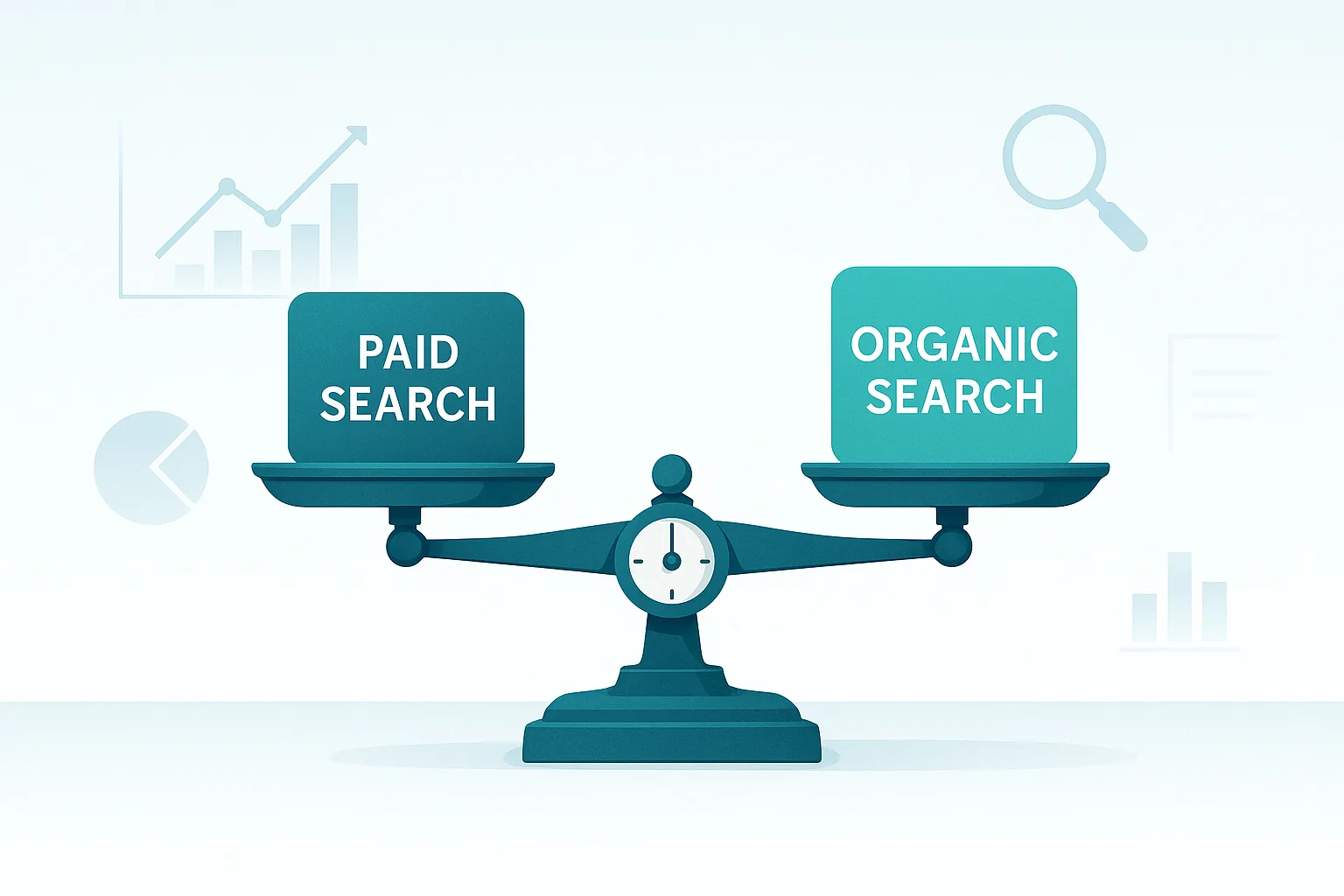
Last summer, I was sitting across from the CMO of a mid-sized SaaS company who looked at me with desperation in his eyes. “Sarah, we’re pouring $50K monthly into Google Ads with diminishing returns, while our organic traffic barely moves the needle. Something’s gotta give.” This conversation wasn’t new to me—after 12+ years in digital marketing trenches, I’ve had this exact discussion countless times. The eternal question: paid search versus organic search strategy—which deserves your precious marketing dollars and attention in 2025?
Here’s the truth no one wants to admit: there’s no one-size-fits-all answer. But there is a right approach for your business, and I’m going to help you find it.
The Search Landscape Has Transformed (And So Should Your Strategy)
When I started in this industry back in 2013, the separation between paid and organic was clear as day. Google’s right sidebar was packed with ads, SEO was a manageable game of keywords and backlinks, and life was, frankly, simpler.
Fast forward to 2025, and holy smokes—what a difference! AI-driven search experiences dominate, zero-click results have exploded, and the real estate for traditional organic listings has shrunk dramatically. Meanwhile, paid search costs have reached eye-watering levels in competitive industries.
Let me be blunt: if your paid search versus organic search strategy hasn’t fundamentally changed in the past two years, you’re probably hemorrhaging money, opportunity, or both.
How I Balance Paid and Organic Search in 2025 for Maximum Impact
The most successful businesses I consult with are adopting a holistic approach that I call “Search Ecosystem Optimization.” This isn’t about choosing one or the other—it’s about understanding how paid search versus organic search strategy elements work together to create multiplier effects.
Take my client in the home fitness equipment space. When we first started working together, they were struggling with an all-or-nothing approach—dumping 80% of their budget into paid search with minimal SEO investment. Their cost-per-acquisition was unsustainable, and they were considering scaling back digital marketing altogether.
Instead, we implemented a balanced strategy focusing on how to balance paid and organic search in 2025:
- We identified high-converting but expensive paid keywords
- Developed comprehensive organic content clusters around those themes
- Used paid search to test messaging before scaling organic content
- Implemented search retargeting between channels
The results? Within six months, their overall search traffic increased by 134%, while their customer acquisition costs dropped by 47%. That’s the power of integration rather than isolation.
The Hard Truth About Paid Search in 2025
Let’s talk about what keeps me up at night as someone managing significant paid search ROI compared to organic search campaigns.
The paid search landscape has become brutally expensive in many sectors. I recently audited an e-commerce campaign where CPCs had increased by 78% year-over-year—with no corresponding increase in conversion rates. That’s terrifying.
The culprits? AI-powered bidding wars, increased competition as more businesses go digital, and Google’s never-ending quest to maximize shareholder value (sorry Google, but it’s true).
Does that mean paid search is dead? Absolutely not. But it does mean the days of “set it and forget it” campaigns are long gone. Today’s successful paid search requires:
Surgical Precision in Audience Targeting
I can’t stress this enough. Broad match keywords and general audiences are budget killers in 2025. My most successful clients are using compound audience targeting—combining demographic data with behavioral signals and purchase intent markers.
My friend Jake, who runs marketing for a luxury watch brand, recently told me: “The moment we switched from general luxury audiences to specifically targeting people who had both researched specific watch complications AND visited luxury travel sites, our conversion rate tripled.” That’s the level of precision required now.
The 80/20 Rule of Paid Keywords
One technique I’ve developed through years of paid search versus organic search strategy implementation is what I call “Conversion Core Concentration.” After analyzing thousands of campaigns, I’ve found that typically 20% of keywords drive 80% of profitable conversions.
The trick is identifying that powerful 20% and relentlessly optimizing it while cutting the rest. This approach has consistently improved paid search ROI compared to organic search performance for my clients.
When Organic Search Still Crushes Paid (Yes, Even in 2025)
Despite what some paid search evangelists might tell you, organic search remains incredibly powerful in specific scenarios. Based on my analysis of various search marketing budget allocation techniques, organic search particularly shines in:
Complex Purchase Decisions With Extended Research Phases
For products or services with longer consideration periods, comprehensive organic content still outperforms paid efforts. My healthcare client saw 3.5x higher conversion rates from users who consumed at least three pieces of their educational content before purchase.
Trust me, I learned this the hard way. In my twenties, I wasted thousands of client dollars pushing high-intent purchase ads for complex B2B software solutions, only to see abysmal conversion rates. People needed information and trust before commitment—precisely what good organic content builds.
Competitive Advantage Through Topic Authority
Google’s helpful content system rewards comprehensive coverage more than ever before. Building genuine topic authority through clusters of high-quality organic content creates a moat around your business that competitors can’t easily overcome.
I’ve seen this work brilliantly for a client in the sustainable home goods space. By creating deeply interconnected organic content around their core sustainability topics, they’ve established such robust topic authority that even competitors with 5x their ad budget struggle to make headway.
The 60/30/10 Framework for Search Marketing Budget Allocation
After implementing dozens of search marketing budget allocation techniques across industries, I’ve developed a framework that serves as a starting point for most businesses:
- 60% to your proven conversion channels (whether paid or organic)
- 30% to developing additional search capabilities and testing
- 10% to experimental search approaches
This framework ensures you’re maximizing current performance while systematically expanding your search footprint—crucial in today’s rapidly evolving landscape.
God, I hate when people stick to rigid frameworks without adaptation, though. This is a starting point, not a commandment. Your specific breakdown will depend on:
- Your industry’s competitive search landscape
- Your business maturity and existing search equity
- Your cash flow situation and ability to invest in longer-term strategies
- Your unique competitive advantages that can be leveraged in search

Paid Search Versus Organic Search Strategy, Paid Search Versus Organic Search Strategy, How to get organic traffic, Paid Search Versus Organic Search Strategy.
5 Scenarios Where Paid Search Decisively Wins in 2025
Based on comprehensive paid search versus organic search strategy analysis across my client portfolio, here are situations where prioritizing paid search makes the most sense:
1. Immediate Revenue Requirements
When my e-commerce clients need quick cash flow—like during a difficult quarter or for seasonal inventory clearance—properly executed paid search delivers fast results that organic simply cannot match.
2. New Market Entry
When entering unestablished markets where you have zero organic presence, paid search provides immediate visibility while your organic strategy develops. A tech client recently used this approach to test European markets before committing to full expansion.
3. Countering Competitive Threats
When competitors are aggressively targeting your brand terms, defensive paid search becomes essential. I’ve seen companies lose 20%+ of their branded traffic by neglecting this area.
4. Highly Transactional, Low-Research Products
For simple impulse purchases with minimal research phases, the direct response nature of paid search often delivers superior ROI. The math just works better.
5. Rapid Testing of Value Propositions
Nothing beats paid search for quickly validating messaging and offers before scaling them through organic channels. This has become a critical part of how to balance paid and organic search in 2025.
The Hybrid Search Approach That's Transforming Results
The businesses seeing extraordinary search performance in 2025 aren’t thinking in silos—they’re implementing synchronized strategies where paid and organic efforts amplify each other.
(And between us, this is where I think most marketing agencies get it wrong—they either specialize in SEO OR paid search, rarely truly integrating them.)
Here’s what the integrated approach looks like in practice:
Content-Driven Remarketing Loops
My financial services client implemented a system where users who consume specific educational content are automatically entered into highly targeted remarketing campaigns with messaging directly tied to the content they consumed. This approach yielded a 217% higher conversion rate than standard remarketing.
Unified Search Data Analysis
By analyzing paid and organic search data together rather than separately, we identify patterns invisible when viewed in isolation. This unified view has helped identify content gaps and keyword opportunities that neither approach would have discovered independently.
Think of paid and organic search like the left and right hemispheres of your digital marketing brain—they process information differently but achieve vastly more when working in harmony.
Paid Search Versus Organic Search Strategy, Paid Search Versus Organic Search Strategy, How to get organic traffic, Paid Search Versus Organic Search Strategy.

Making the Right Choice for Your Business: 3 Essential Questions
To determine whether to prioritize paid search versus organic search strategy for your specific situation, answer these questions honestly:
1. What’s Your True Time Horizon?
If you need results within months rather than years, paid search will need to be your primary focus. Organic search is more powerful than ever in 2025, but it still operates on a longer timeline.
Last year, I worked with a startup that needed to show traction to investors within three months. We had no choice but to focus 80% of resources on paid search. However, we simultaneously laid the groundwork for organic growth that’s now bearing fruit.
2. What’s Your Competitive Advantage?
Your unique strengths should influence your paid search ROI compared to organic search investment decisions.
Do you have exceptional writers and subject matter experts? Organic search might deliver better returns. Have significant capital but limited content creation resources? Paid search might be your path forward.
3. Where Are Your Customers in Their Journey?
Understanding your customers’ search behavior is critical to appropriate search marketing budget allocation techniques.
One of my B2B clients discovered through research that 70% of their potential customers began with educational, problem-identification searches—perfect for organic content. However, the final 20% of their journey involved highly specific solution comparison where paid search excelled.
Future-Proofing Your Search Strategy for 2025 and Beyond
If there’s one constant in search marketing, it’s change. Here’s how I’m preparing my clients for what’s coming next:
Embrace AI-Generated Search Experiences
The rise of AI-generated search results means both paid and organic strategies need adaptation. I’m currently testing AI-optimized content structures that maintain visibility in these new formats.
Voice Search Finally Matters (For Real This Time)
After years of false starts, voice search is genuinely impacting search behavior in specific industries. For local and service businesses especially, optimizing for conversational queries is becoming essential.
The Coming Privacy Transformations
As privacy regulations continue to evolve, tracking and attribution for paid search will become more challenging. This actually strengthens the case for organic search investment as a hedge against further paid search complications.
My Final Verdict: Integration Beats Selection
After 12+ years of managing paid search versus organic search strategy decisions for businesses ranging from startups to enterprises, my conclusion is clear: the question isn’t which to choose, but how to integrate them effectively.
The most successful search marketing approach in 2025 is one that:
- Acknowledges the unique strengths and limitations of each channel
- Creates synchronized campaigns where paid and organic efforts reinforce each other
- Maintains flexibility to shift resources as conditions change
- Builds long-term search equity while delivering short-term results
Remember my desperate CMO client I mentioned earlier? Six months after implementing an integrated approach, his organic traffic was up 87%, paid search conversion rates improved by 42%, and for the first time in years, he was sleeping through the night.
And honestly, helping marketers sleep better might be my greatest professional achievement.
What’s your biggest challenge in balancing paid and organic search? I’d love to hear about your specific situation in the comments below—or reach out directly if you’d like a personalized assessment of your current approach.
FAQs About Paid Search Versus Organic Search Strategy
1. How long does it typically take to see results from organic search compared to paid search?
In my experience, paid search can generate results almost immediately (within days or weeks), while organic search typically takes 3-6 months to show significant movement. That said, I’ve had clients who saw organic improvements in as little as 4-6 weeks with aggressive content strategies targeting low-competition niches.
2. Is it better to start with paid search and then transition to organic?
This approach makes sense for many businesses, especially those needing immediate visibility. I often recommend using paid search as a “bridge strategy” while building organic presence. The data from your paid campaigns can also inform your content development, making your eventual organic strategy more effective.
3. What percentage of marketing budget should typically go to search marketing in 2025?
This varies dramatically by industry, but for digitally-focused businesses, I typically see 30-50% of marketing budgets allocated to combined search efforts. B2B companies often skew higher (35-55%) while consumer brands with strong social components might allocate 20-40%.
4. How has AI changed the paid search versus organic search strategy equation?
AI has impacted both sides dramatically. For paid search, AI bidding platforms have increased competition and costs while improving targeting precision. For organic search, AI-generated content has raised the quality bar significantly while AI-driven search experiences have reduced traditional organic click-through rates. The net effect actually emphasizes the need for integration rather than choosing one approach.
5. How do you measure success differently between paid and organic search?
While both ultimately connect to revenue, I track them with different metrics initially. For paid search, I focus on ROAS (Return on Ad Spend), conversion rate, and quality score. For organic search, I track organic visibility growth, click-through rates, and engagement metrics before connecting to conversion data. The timeframes for performance evaluation also differ—weekly for paid, monthly for organic.
6. How do I know if my industry is better suited for paid or organic search?
Analyze these factors: average CPC in your industry (higher CPCs often make organic more attractive), purchase complexity (complex decisions favor organic), competition levels (extreme competition in either channel might suggest focusing on the alternative), and search volume patterns (consistent search volume favors organic investment).

