


The morning I walked into my first banking job back in 2010, I had no idea how dramatically different that same role would look fifteen years later. Armed with my fresh BBA Finance degree and overpriced suit, I spent my days processing loan applications, monitoring transactions, and explaining basic financial products to customers. God, I miss the simplicity of those days sometimes. The AI transformation in entry-level banking had barely begun then, but today? It’s completely revolutionized what it means to start a career in banking.
I’ve spent the last decade and a half watching this evolution first-hand—from traditional banking operations to implementing AI systems at major financial institutions and now consulting with banks on their digital transformation journeys. Trust me when I say that what BBA Finance students need to succeed has fundamentally changed.
The Vanishing Act: Traditional Banking Roles That AI Is Replacing
Remember when banks had rooms full of entry-level employees processing transactions and doing data entry? My first manager used to say, “Banking is built on the backs of recent graduates.” Not anymore. The AI transformation in entry-level banking has automated many of those stepping-stone positions that generations of finance professionals used to cut their teeth on.
Last summer, I consulted for a mid-sized regional bank that reduced its transaction processing team from 22 recent graduates to just 5 oversight specialists in less than 18 months. The AI systems they implemented didn’t just match human accuracy—they exceeded it by eliminating nearly all manual input errors while processing transactions 24/7.
Here’s the hard truth I tell my business school students: if your job can be reduced to a series of predictable decisions or data manipulations, AI is probably already doing it somewhere in the industry. And it’s doing it faster, cheaper, and more accurately than humans ever could.
Which Entry-Level Roles Are Most Vulnerable to the AI Revolution?
The AI transformation in entry-level banking isn’t affecting all positions equally. Some traditional starter positions are disappearing much faster than others:
- Transaction processing specialists: Nearly extinct already, with automation handling 80-95% of routine transactions at most institutions.
- Basic customer service representatives: Being rapidly replaced by sophisticated AI chatbots and virtual assistants.
- Data entry and validation roles: Practically eliminated by automated data extraction and validation systems.
- Basic loan processors: Increasingly automated through algorithmic underwriting systems.
A colleague who manages university recruitment for a major bank told me they’ve reduced entry-level hiring by almost 40% over the past five years while increasing their technology department hiring by 70%. That’s not a temporary trend—it’s the new reality of banking automation impact on finance careers.
The New Banking Landscape: What Does AI Actually Do?
Before panicking about the robot apocalypse in banking (I’ve seen enough anxiety-ridden faces in my classroom to know that’s where some minds go), let’s break down what AI is actually doing in banks today. Understanding the technology is the first step in your future-proof banking career preparation.
Customer Interaction Automation
AI-powered chatbots and virtual assistants have moved far beyond the irritating “computer says no” systems of the early 2010s. Modern banking AI uses natural language processing to understand customer needs, answer questions, and even detect emotional cues in text or voice conversations.
My niece recently got her first credit card and told me she had a “great conversation with the bank rep” about building her credit score. Only after twenty minutes did she realize she had been chatting with an AI the whole time! That’s how sophisticated these systems have become.
Algorithmic Decision Making
Remember when loan decisions required human judgment? Now, AI systems evaluate credit applications by analyzing hundreds of data points in seconds. One bank I worked with implemented a system that could process and make preliminary decisions on mortgage applications in under five minutes—a task that used to take days of human review.
The AI transformation in entry-level banking has turned what was once a job for recent graduates into an algorithmic process that’s faster, more consistent, and often more accurate than human judgment.
Fraud Detection and Risk Assessment
In my twenties, I spent two years on a fraud detection team, manually reviewing flagged transactions and investigating patterns. It was detail-oriented work that taught me a lot about banking operations, but also involved endless hours staring at spreadsheets. Today, machine learning systems can analyze millions of transactions simultaneously, identifying subtle fraud patterns that human reviewers would likely miss.
A former colleague who still works in fraud prevention told me their AI system recently caught a sophisticated fraud ring that had escaped detection for months under the previous human-only review system. The AI identified correlations across thousands of seemingly unrelated transactions that no human team could have connected.
Process Automation
The banking automation impact on finance careers is perhaps most visible in back-office operations. Robotic Process Automation (RPA) has eliminated countless entry-level positions that involved repetitive tasks like data entry, reconciliation, and document processing.
I visited a bank’s operations center last year that used to employ over 200 people. Now it runs with just 40, yet processes three times the volume of work. The remaining employees focus on exception handling, oversight, and customer issues that require human judgment.
The Human Advantage: Banking Skills AI Can't Replace (Yet)
Despite the dramatic impact of the AI transformation in entry-level banking, there remain crucial areas where human skills maintain a decisive advantage. These are the capabilities you should focus on developing during your BBA Finance program to ensure you remain valuable in an increasingly automated industry.
AI Transformation in Entry-Level Banking, AI Transformation in Entry-Level Banking, AI Transformation in Entry-Level Banking.
Complex Problem Solving
AI excels at solving well-defined problems but struggles with novel situations requiring creative thinking. Last year, I watched a junior analyst at a client bank develop an innovative restructuring approach for a struggling business client by connecting seemingly unrelated market trends—something no AI system could have conceived.
To develop this skill:
- Take courses that present open-ended business problems
- Participate in case competitions
- Look for internships that expose you to atypical business situations
Emotional Intelligence and Relationship Building
Despite advances in natural language processing, AI still can’t truly understand or reciprocate human emotions. Banking remains a relationship business at its core.
I still remember when my first boss took me along to meet an important client facing financial difficulties. The way she navigated that emotionally charged conversation—showing empathy while still representing the bank’s interests—taught me more about banking than any textbook could. That human connection is something the AI transformation in entry-level banking hasn’t replaced.
Ethical Judgment
Banks increasingly need professionals who can navigate complex ethical questions around AI implementation. Who’s responsible when an algorithm denies a loan unfairly? How do we ensure AI doesn’t perpetuate existing biases?
These questions require human judgment informed by ethical principles and contextual understanding. They’ve become central to future-proof banking career preparation in today’s environment.
The Must-Have Skills: What BBA Finance Students Need to Develop Now
If I could go back and whisper advice to my younger self—that nervous new graduate in her too-stiff suit—I’d focus on developing these skills that have become essential in the age of AI transformation in entry-level banking:
Data Literacy and Analysis
You don’t need to become a data scientist, but you absolutely must understand how to interpret data, recognize its limitations, and translate analytical insights into business decisions. Every successful banking professional I know under 35 has strong data skills.
The ability to ask the right questions of data has become more valuable than many traditional banking skills. I’ve seen promising careers stall because professionals couldn’t adapt to this data-driven environment.
Technology Comprehension
You don’t need to code (though basic Python skills are increasingly valuable), but you do need to understand how technologies like AI, blockchain, and cloud computing are reshaping banking. More importantly, you need to grasp their business implications rather than just their technical functionality.
A former student of mine recently landed an excellent position at a major bank despite competing against candidates with more experience. The difference? She could articulate how emerging technologies would impact their specific business lines and customer relationships.
Critical Assessment of AI Outputs
As AI systems make more decisions, banks need humans who can effectively supervise these systems and critically evaluate their outputs. This requires understanding both the business context and the basics of how these systems work.
I consult with a bank that recently avoided a potential disaster because an alert junior team member questioned an AI-generated risk assessment that missed crucial regulatory changes. Her critical thinking saved the bank from what could have been significant compliance issues.
Adaptability and Continuous Learning
The most successful banking professionals I know have embraced perpetual learning. The half-life of technical skills has shortened dramatically, making the ability to quickly acquire new knowledge more important than any specific skill set.
Trust me, I learned this the hard way. In my thirties, I had to completely reinvent my skill set when my specialized knowledge in traditional banking operations suddenly became much less valuable. Now I tell students that future-proof banking career preparation means developing a learning system that will serve you throughout your career.
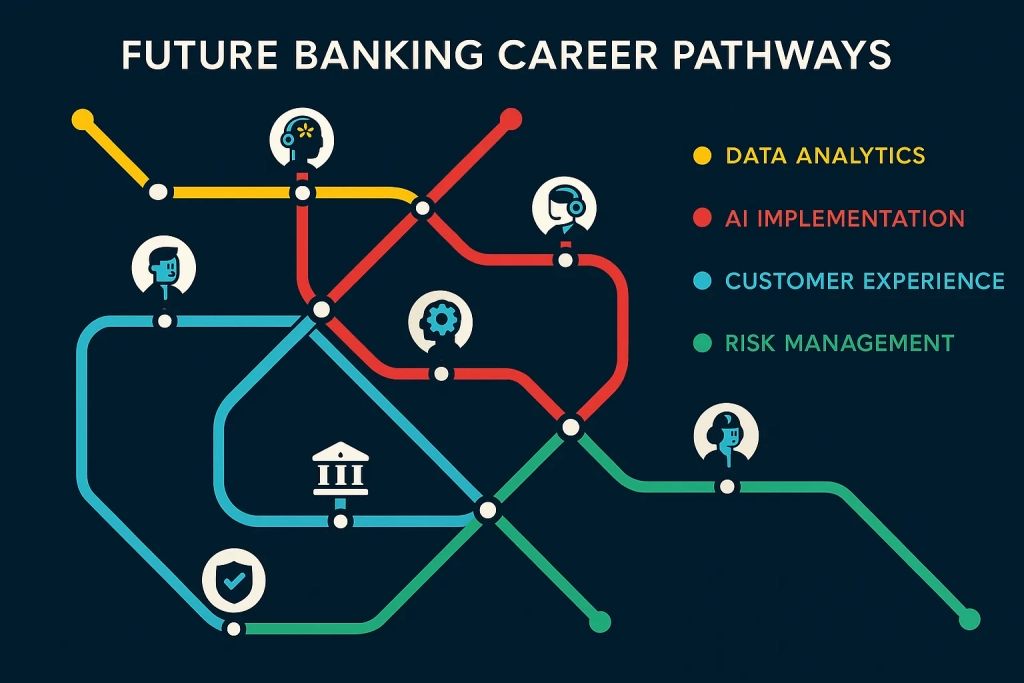
The Evolving Entry Points: New Pathways into Banking
The traditional entry-level positions that have served as banking career gateways for generations are disappearing, but new entry points are emerging that align with the AI transformation in entry-level banking:
AI Implementation Teams
Banks increasingly need professionals who can bridge the gap between technical teams developing AI solutions and the business units implementing them. These roles require understanding both the technology and the specific banking functions it supports.
A colleague who leads AI implementation at a major bank told me they now specifically recruit finance graduates with technology exposure rather than computer science graduates, as they need people who understand both worlds.
Customer Experience Design
As routine interactions become automated, banks are investing heavily in redesigning the remaining human touchpoints to be more valuable and meaningful. This creates opportunities for graduates who understand both customer psychology and financial services.
Risk and Compliance Evolution
Regulatory technology (RegTech) is transforming compliance functions, but this area still requires significant human oversight. Entry-level positions in these departments increasingly involve working alongside AI systems to ensure regulatory compliance.
Product Development and Innovation
With traditional revenue streams under pressure from fintech competitors, banks are investing in new product development. These teams need fresh thinking and often provide opportunities for new graduates to contribute meaningfully from day one.

Comparing Traditional vs. AI-Transformed Banking Careers
Let me break down how the typical career progression has changed due to the AI transformation in entry-level banking:
| Career Aspect | Traditional Banking Path (Pre-AI) | AI-Transformed Banking Path |
|---|---|---|
| Entry Point | Transaction processing, customer service, data entry | AI implementation, data analysis, customer experience design |
| Key Skills | Financial product knowledge, attention to detail, regulatory compliance | Data literacy, technology comprehension, adaptive learning, critical thinking |
| Career Progression | Linear advancement through predefined roles | More fluid movement between technical and business functions |
| Learning Curve | Steep initially, then plateauing | Continuously steep as technology evolves |
| Promotion Factors | Tenure, accuracy, procedural knowledge | Innovation capability, technology integration, business impact |
| Job Security | Based on institutional knowledge and experience | Based on adaptability and continuous skill development |
| Work Environment | Structured, process-oriented | Dynamic, project-based, collaborative |
This transformation represents both challenge and opportunity. The banking automation impact on finance careers has eliminated many traditional jobs but has also created new roles that offer more interesting work and often faster advancement for those with the right skill set.
How Universities and BBA Programs Need to Adapt
I teach part-time at a business school, and I’ll be honest—many finance programs are not keeping pace with the AI transformation in entry-level banking. If your program isn’t offering these elements, seek them out independently:
Practical Data Analysis Experience
Theory isn’t enough. You need hands-on experience working with real financial data sets and drawing business conclusions from them. Look for courses that use actual banking data in their assignments.
Exposure to Banking Technology
Seek out opportunities to learn about the specific AI and automation technologies being deployed in banking. Even better, look for internships or projects where you can see these systems in action.
Cross-Disciplinary Learning
The most valuable banking professionals I know can bridge technical, financial, and human considerations. Take some computer science courses alongside your finance curriculum, and perhaps some psychology or design thinking as well.
Real-World Problem Solving
Case competitions, industry projects, and internships that expose you to actual banking challenges are worth their weight in gold. They teach the contextual thinking that AI still struggles with.
My Personal Advice: How to Prepare for an AI-Transformed Banking Career
After fifteen years in this evolving industry, here’s what I wish every BBA Finance student understood about preparing for the AI transformation in entry-level banking:
Start Building Your Technical Literacy Now
You don’t need to become a programmer, but familiarize yourself with the basic concepts and terminology of AI, machine learning, and data analytics. Resources like Coursera, edX, and even YouTube offer excellent introductions. When I hired for my last team, candidates who could speak intelligently about these technologies immediately stood out.
Develop a Learning System
The specific tools will change throughout your career, but the need to quickly assimilate new knowledge won’t. Find the learning approaches that work best for you and practice acquiring new skills regularly. I block out five hours every week specifically for learning—it’s a non-negotiable appointment on my calendar.
Seek Hybrid Experiences
The most valuable banking professionals in the coming decade will be those who can bridge technical and business worlds. Look for internships or projects that expose you to both the technology implementation and the business impact sides of banking.
Build Your Human Skills Deliberately
As AI handles more analytical tasks, distinctly human capabilities become more valuable. Join clubs or activities that build your communication skills, emotional intelligence, and ethical reasoning. In my experience, these are the differentiators that lead to leadership roles in the transformed banking industry.
Embrace the Change
The AI transformation in entry-level banking isn’t something to fear—it’s an opportunity to build a more interesting, impactful career than was possible in traditional banking structures. The routine work being automated was never the most fulfilling part of banking anyway.
Final Thoughts: The Future Belongs to the Adaptable
When I look back at my fifteen years in banking, the professionals who thrived through this transformation weren’t necessarily the most technically brilliant or the most experienced in traditional banking. They were the ones who remained curious, adaptable, and willing to reinvent themselves as the industry changed.
The AI transformation in entry-level banking has permanently altered the career landscape for BBA Finance graduates. But I firmly believe that this new landscape offers more intellectually stimulating work, faster advancement opportunities, and greater impact potential than the banking industry I entered.
Your future-proof banking career preparation starts now, with the choices you make about what to learn, what experiences to seek, and what mindset to cultivate. The traditional banking career ladder may be disappearing, but it’s being replaced by something potentially more rewarding for those willing to adapt.
The future of banking still needs human intelligence, creativity, and judgment—qualities that no AI system can truly replicate. By developing the right combination of technical literacy and distinctly human skills, you’ll be positioned not just to survive but to thrive in the transformed banking industry.
I’d love to hear your thoughts and questions about navigating your banking career in this AI-transformed landscape. Drop a comment below or reach out directly—this conversation is just beginning.
Frequently Asked Questions
Do I need to learn programming to succeed in entry-level banking roles?
While not absolutely required, basic programming knowledge (particularly Python) is increasingly valuable. More important is understanding data analysis concepts and being able to work with technical teams effectively. I’ve seen many successful banking professionals who don’t code but understand enough technical concepts to bridge business and technology functions.
Which traditional entry-level banking roles are least threatened by AI automation?
Roles involving complex client relationships, creative problem-solving, and significant human judgment remain the most resilient to automation. These include certain aspects of wealth management, specialized lending, strategic advisory services, and innovation teams.
How quickly is AI changing the banking industry?
The pace of change has accelerated dramatically in the past 3-5 years. What used to be five-year transformation projects are now being implemented in 12-18 months. The COVID-19 pandemic further accelerated digital transformation timelines across the industry.
Should I focus on technical skills or business knowledge in my BBA program?
You need both, but the ideal balance depends on your career goals. For most banking roles, I recommend building a strong finance foundation while developing enough technical literacy to work effectively with technology teams and understand AI systems’ capabilities and limitations.
How can I make myself valuable in an increasingly automated banking environment?
Focus on developing skills that complement rather than compete with AI systems. These include creative problem-solving, complex communication, ethical judgment, relationship building, and the ability to translate between technical and business considerations.
Are there any new entry-level roles being created by AI in banking?
Yes! Emerging roles include AI implementation specialists, banking customer experience designers, model risk validators, alternative data analysts, and financial technology liaisons. Many of these roles offer faster advancement potential than traditional banking career paths.

