

The Ultimate Guide to Marketing: Unlocking the Incredible Career Potential with a BBA in Marketing
Introduction: My Journey into the Marketing Universe
Let me take you back to 2015. Picture this: I’m hunched over my laptop in my dorm room that permanently smelled like instant ramen, frantically searching “what is marketing for business students” while simultaneously texting my dad that, yes, I was sure I didn’t want to go to law school. I was caught between wanting to do something creative and needing something that would actually pay my bills. Understanding the BBA in Marketing career scope seemed like it might bridge that gap, but honestly? I had no clue what I was getting myself into.
I’m Alex Martinez, and that clueless college kid eventually spent the next decade-plus navigating the marketing world—from getting coffee and creating PowerPoints as a junior brand assistant at P&G (where I once accidentally sent an unfinished draft to our CMO, nearly giving myself a heart attack), to eventually leading digital strategy at Spotify (during what my therapist calls “the years of perpetual burnout”), to finally running my own marketing consultancy today.
What is marketing for business students? It’s not what most people think it is. It’s not just making things look pretty on Instagram or coming up with catchy jingles (though, not gonna lie, I did once spend three days obsessing over a tagline that ultimately got scrapped anyway). It’s this wild fusion of psychology, data nerdery, creativity, and business strategy that keeps morphing just when you think you’ve got it figured out. And despite the stress, tight deadlines, and occasional existential crises, I freaking love it.
So let’s talk about what marketing actually is, and why exploring the BBA in Marketing career scope might be the best career move you never knew you wanted to make.
What Is Marketing? (Hint: It's Not Just About Selling Stuff)
First things first—let’s ditch the textbook definition I had to memorize for my Marketing 101 final. You know, that boring line about “identifying, anticipating, and satisfying customer needs profitably.” Technically accurate, but about as inspiring as unseasoned chicken.
Marketing, at its heart, is about building bridges between products and the humans who might need them. It’s about understanding what makes people tick—their hopes, fears, desires, and pain points—then showing them how your product or service fits into their lives in a meaningful way.
My mentor at P&G (who had this unnerving habit of maintaining eye contact for uncomfortably long periods) summed it up brilliantly during my first week: “Marketing is storytelling with purpose.” Not just any stories, but ones that connect people with solutions to their problems in a way that actually resonates.
Here’s what marketing actually looks like in today’s messy, complicated business world for students exploring what is marketing for business students:
The Real Elements of Modern Marketing
- Market Research and Consumer Behavior Analysis My first two years at P&G were basically an extended crash course in figuring out why people do what they do. I spent countless hours watching focus groups through two-way mirrors, analyzing survey data until my eyes burned, and once even following shoppers around stores like some weird stalker (it was called “observational research” to make it sound less creepy). People will tell you they make rational decisions. They don’t. My favorite example? We once ran a test where we changed nothing about a product except making the packaging slightly heavier, and satisfaction scores jumped 23%. TWENTY-THREE PERCENT for the exact same product that just felt more substantial in people’s hands!
- Brand Development and Management Your brand isn’t your logo. It’s not your color scheme or your font choice. It’s the gut feeling people get when they think about your company. My biggest professional embarrassment came from overlooking this fact during a major product launch in 2018. We had killer ads, amazing product design, stellar packaging… but we hadn’t considered how it fit into the overall brand perception. The disconnect was jarring, and we paid for it with disappointing sales and a very uncomfortable meeting with executives.
- Strategic Marketing Planning I’m naturally impatient, which has bitten me in the ass repeatedly throughout my career. During my second year at P&G, I pushed to launch a product variation without properly mapping out how it fit into our long-term brand architecture. The team was excited, leadership was impressed with my initiative, and we rushed it to market… where it promptly crashed and burned so spectacularly that it became a cautionary tale in the department. Lesson painfully learned.
- Digital Marketing and Analytics When I started in marketing, digital was considered the “fun, experimental” side of things where the serious metrics didn’t apply. Fast forward to my time at Spotify, and our entire marketing department literally revolved around data dashboards that tracked everything from broad campaign performance to which exact shade of blue got more clicks on a specific day of the week. Understanding traditional vs digital marketing careers has become crucial for anyone entering the field today. The pendulum has honestly swung too far in some ways. Last year, one of my clients was so obsessed with optimizing their metrics that they completely lost sight of the creativity that made their brand special in the first place. Finding balance is the real challenge here.
- Product Development and Management Here’s something they didn’t teach me in business school: great marketing starts way before there’s even a product to market. Some of my most fulfilling work has been sitting with product teams early in the development process, bringing customer insights that fundamentally changed what got built. My friend Tara (who’s now a Chief Product Officer at a fintech startup) always says, “The best marketing is baked into the product, not slapped on afterward.” She’s annoyingly right about that.
Why Choose a BBA in Marketing? The Foundation That Launched My Career
When I was choosing my specialization, my dad pushed hard for finance (“stable career, Alex!”), mom suggested human resources (“you’ve always been good with people!”), and my academic advisor pitched operations management. I went with marketing partly because it seemed like the most interesting option and partly because my crush was also a marketing major (shameful but true).
In retrospect, it was accidentally one of the best decisions I’ve made. Here’s why understanding the BBA in Marketing career scope matters:
The Perfect Blend of Creative and Analytical Skills
Marketing is weirdly balanced between art and science. Last summer, I guest-lectured at my alma mater and asked the students about their choice of major. One kid—clearly hungover but still insightful—said, “I suck at pure creativity, but I also hate jobs where I’m just crunching numbers all day. Marketing seems like the sweet spot.”
Couldn’t have said it better myself. In a typical day, I might dive deep into campaign analytics in the morning (discovering, for instance, that our perfectly crafted campaign was actually performing 30% better with people over 55 than our target demographic of 25-34 year olds—oops), then switch to brainstorming creative concepts or taglines in the afternoon.
This mental flexibility isn’t just intellectually stimulating—it’s also a career insurance policy. When evaluating traditional vs digital marketing careers, being able to toggle between creative and analytical roles gives you options when the economy goes through its inevitable ups and downs.
Real-World Application From Day One
The best thing about studying marketing was how immediately applicable everything felt. My roommate was studying theoretical physics and constantly complained that he couldn’t explain to his parents what practical value his education had. Meanwhile, I was analyzing real marketing campaigns, developing actual marketing plans, and even implementing projects for local businesses.
During junior year, our marketing strategy class partnered with a local bakery that was struggling after a decade of success. The owner—this amazing woman named Gloria who would bring us still-warm pastries during our meetings—implemented our recommended targeting strategy and social media approach. Six months later, she sent our professor a bottle of champagne because their sales had increased 40%. That kind of immediate impact is addictive.
The Curriculum That Shapes Marketing Professionals
Understanding what is marketing for business students means exploring a curriculum that typically includes courses like:
- Principles of Marketing (aka “yes, there will be group projects”)
- Consumer Behavior (surprisingly fascinating studies of why humans make terrible decisions)
- Marketing Research Methods (where you’ll learn the difference between correlation and causation, hopefully)
- Brand Management (featuring case studies of spectacular brand failures)
- Digital Marketing (which will be partially outdated by the time you graduate, through no fault of your professors)
- International Marketing (cultural sensitivity crash course)
- Integrated Marketing Communications (fancy way of saying “make sure all your messages make sense together”)
- Marketing Strategy and Planning (the “big picture” stuff that impresses executives)
- Product and Service Management (how not to launch a disaster)
- Retail Marketing (increasingly digital, but brick-and-mortar isn’t dead yet)
What they don’t mention in the brochures: the quality of your marketing program depends heavily on how connected it is to the actual industry. My program included workshops with real businesses facing actual marketing challenges, certification preparation for tools like Google Analytics (which saved me about $500 in training costs later), and brutally honest guest lectures from industry veterans who weren’t trying to recruit us so they had no reason to sugarcoat anything.
The professor who influenced me most, Dr. Reyes, had spent 15 years in consumer packaged goods marketing before teaching. He would constantly interrupt his own lectures with “Now, here’s what the textbook says… and here’s what actually happens in the real world.” Those divergences were always the most valuable parts of class.
The Incredible Career Scope for BBA Marketing Graduates
Now for what you’re probably most curious about—the BBA in Marketing career scope. What can you actually DO with this degree? Where might you end up five, ten, or fifteen years down the road?
Traditional Marketing Roles That Remain Relevant
Understanding traditional vs digital marketing careers starts with recognizing that despite all the changes in marketing (and there have been MANY since I started), certain traditional roles continue to offer solid career paths:
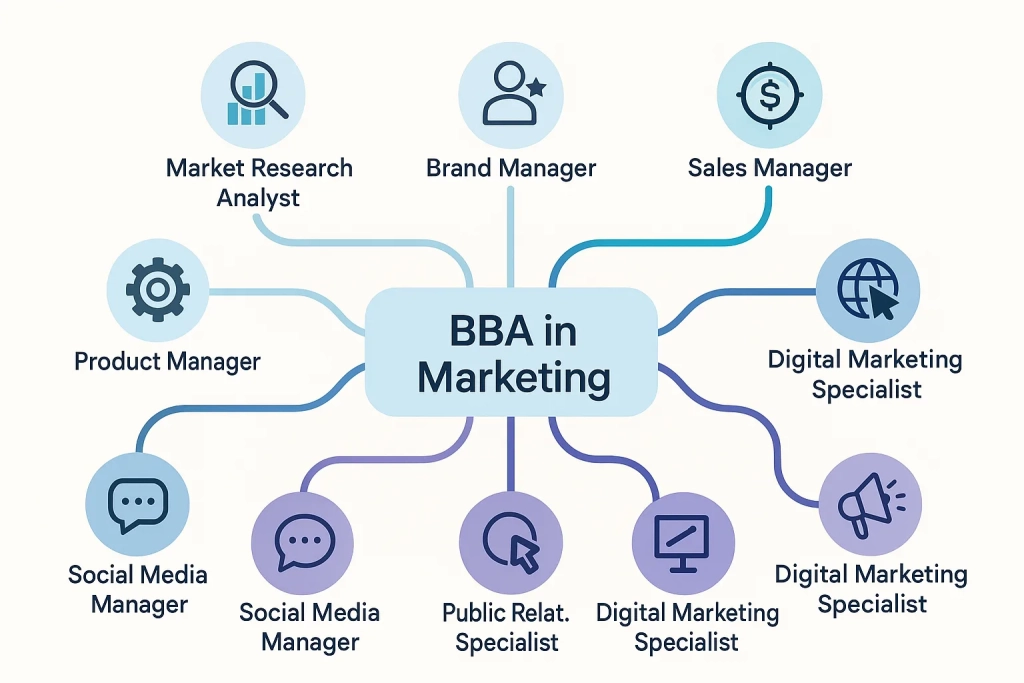
- Brand Manager This was my first “real” role after my initial assistant position at P&G. Brand managers are like mini-CEOs responsible for the overall strategy and performance of a product or service line. It’s a role that combines strategic thinking with tactical execution and typically offers a clear promotion path. My business school friend Jamie started as an assistant brand manager for a cereal brand that your kids probably love, progressed to brand manager after two years, and now oversees a portfolio worth over $500 million. But fair warning: the hours can be brutal. Jamie missed his daughter’s first birthday party because of an emergency product recall situation. That kind of stuff happens more than companies like to admit.
- Market Research Analyst If you’re fascinated by why people make the decisions they make, this might be your path. These roles involve gathering and interpreting data about consumers and competitors. My former colleague Rita started in market research, specialized in qualitative methodologies, and eventually leveraged her expertise in consumer psychology to launch a consulting practice that now makes her twice what I earn (a fact she never lets me forget during our quarterly dinner catch-ups).
- Advertising and Promotions Manager Want to be the person who develops advertising campaigns across various media channels? This path lets you work closely with creative teams while maintaining the business perspective. Many of the creative directors I collaborated with at our partner advertising agency started in these roles before moving to the agency side. Others stayed client-side and eventually moved up to marketing director positions.
Emerging Digital Marketing Careers
When comparing traditional vs digital marketing careers, it’s important to note that the digital revolution has created entirely new marketing specializations that simply didn’t exist when I was in college:
- Social Media Manager In 2015, companies were still debating whether social media was a fad. By 2019, we hired a dedicated social media specialist at Spotify who had just graduated with her BBA. Within two years, she was managing a team of five and overseeing content that reached millions daily. Her secret? Understanding that social platforms are conversation spaces, not broadcast channels—something many larger brands still haven’t figured out.
- SEO/SEM Specialist Search engine optimization and marketing require a unique blend of technical knowledge, content sensitivity, and strategic thinking. These specialists ensure businesses appear prominently in search results—both organic and paid. The technical yet creative nature of this work often commands premium salaries. My former intern Connor specialized in technical SEO and now works remotely for a SaaS company, making well into six figures while living in a small town with a ridiculously low cost of living. Smart kid.
- Content Marketing Strategist Content marketing has evolved from “just write some blog posts” to a sophisticated discipline involving audience segmentation, content journeys, and attribution modeling. These strategists develop and execute content plans that attract and engage specific audiences. My current content strategist previously worked as a journalist for a major publication. The storytelling and research skills transferred beautifully to marketing, though I had to help her unlearn some of the “objective reporting” mindset when creating persuasive content.
- Marketing Analytics Manager As marketing becomes increasingly data-driven, professionals who can extract meaningful insights from complex datasets are practically being fought over by companies. One of my former interns specialized in marketing analytics and now earns more than I did after ten years in the field—just three years after graduation. I’m simultaneously proud and slightly bitter about it.
- E-commerce Marketing Specialist The explosion of online shopping, dramatically accelerated by the pandemic, has created huge demand for marketers who understand the unique dynamics of e-commerce platforms. My client Sarah leveraged her BBA Marketing background and passion for sustainable products to launch an e-commerce marketing agency focused on eco-friendly brands. Her company hit seven figures in revenue within 18 months of launching—largely because she recognized and filled a specific niche that traditional agencies weren’t serving well.
Beyond Traditional Marketing Departments
What truly excites me about the BBA in Marketing career scope is how it prepares you for roles beyond the marketing department:
- Customer Experience Designer My classmate David used his marketing knowledge as a foundation to become a customer experience designer for a major airline. He completely transformed their service approach by applying customer journey mapping techniques he learned in marketing to the travel experience. He says marketing gave him the “customer empathy” that many operations-focused colleagues lacked.
- Product Manager The consumer insights and strategic thinking from marketing education make BBA graduates excellent candidates for product management roles, where they can bridge technical capabilities with market needs. My marketing team colleague Zoe transitioned to product management after consistently providing valuable market insights to our product team. She’s now a Senior Product Manager earning about 30% more than she would have on the marketing track, with more direct influence on what gets built.
- Entrepreneurship Marketing knowledge is absolutely critical for entrepreneurs. Understanding your target market, communicating your value proposition, and building a brand are essential entrepreneurial skills that marketing education directly addresses. In my late twenties, I started a small marketing consultancy on the side that eventually grew into the business I run today. The foundation from my BBA in Marketing was invaluable in figuring out how to position my own services—though I still made plenty of mistakes along the way (like severely underpricing my services for the first year because I was afraid to charge what I was worth).
How to Succeed with a Marketing Degree: Building Your Career
If you’re considering this path—or already on it—here are some tactics on how to succeed with a marketing degree that I wish someone had shared with me when I was starting out:
Beyond the Classroom: Building Real Marketing Muscle
The honest truth? Your coursework alone won’t come close to preparing you for marketing success. The students from my program who achieved the most impressive careers all did these things:
- Get Certified in Digital Tools While your BBA covers the theory, practical tool knowledge sets you apart. Google Analytics, HubSpot, Facebook Blueprint, and other certifications signal to employers that you can contribute immediately. I procrastinated on getting Google Analytics certified until after graduation and immediately regretted it when I saw how many job descriptions listed it as a requirement. Don’t be like me—start collecting these certifications while you’re still in school when you have more time and less pressure.
- Create Real Campaigns Don’t wait for permission or perfect conditions. When I was a sophomore, I approached three local businesses and offered to run their social media for free. One ghosted me, one politely declined, and one—a family-owned coffee shop—took a chance on me. The portfolio I built from that single opportunity helped me land my P&G internship over candidates from more prestigious schools. The coffee shop owner became a mentor and friend, eventually investing in my consultancy years later. You never know where these connections might lead.
- Network Strategically Learning how to succeed with a marketing degree means understanding that building professional relationships is crucial. I hate the term “networking”—it sounds so transactional and fake. But it’s essential in marketing. Join professional associations like the American Marketing Association, attend industry conferences (even virtually), and connect with marketing professionals for informational interviews. One coffee meeting I reluctantly attended during finals week in my senior year—seriously, I almost canceled three times—led to a connection that eventually helped me land my role at Spotify years later. The marketing world is smaller than you think, and reputation travels fast (both good and bad).
- Develop Adjacent Skills The most successful marketers I know have complementary skills that make them uniquely valuable. Basic coding, graphic design, video editing, public speaking, or data visualization can dramatically increase your marketability. I taught myself basic HTML and CSS during a summer break, and that minimal technical knowledge has paid dividends throughout my career—from being able to fix urgent website issues when the development team was unavailable to understanding technical constraints when planning digital campaigns.
The Future of Marketing: Where Is the Field Heading?
After witnessing dramatic shifts in the marketing landscape over my career (remember when QR codes were considered dead tech before the pandemic revived them?), I’ve developed some perspectives on where traditional vs digital marketing careers are heading next:
AI and Automation Are Changing the Game
I was initially terrified that AI would make my job obsolete, but I’ve come to see it differently. Artificial intelligence is transforming marketing functions from content creation to customer segmentation, but it’s enhancing human marketers rather than replacing them.
At my consultancy, we’ve integrated AI tools that handle routine analytics tasks and generate preliminary content outlines, freeing our human experts to focus on strategy and creative direction—the parts where human judgment and emotional intelligence still far exceed machines.
The BBA in Marketing graduates who will thrive in the next decade will be those who understand how to succeed with a marketing degree by collaborating with AI tools rather than competing with them. Learn how these tools work now so you can direct them effectively later.
Personalization at Scale
The holy grail of modern marketing is delivering experiences that feel individually tailored while still being efficient enough to scale. During my Spotify days, I witnessed firsthand how our personalized playlists and recommendations dramatically increased user engagement and retention.
The challenge lies in balancing personalization with privacy concerns—a tension that will define marketing ethics discussions for years to come. I’ve advised clients against certain data collection practices that, while technically legal, felt ethically questionable. Your career longevity depends on building trust, not just short-term results.
Purpose-Driven Marketing
Consumers increasingly support brands that stand for something beyond profit—especially younger consumers who will soon represent the bulk of purchasing power. The most compelling marketing now aligns with authentic values and social purpose.
I’ve advised several clients to reconsider their positioning to highlight genuine commitments to sustainability or community impact—not as a marketing tactic but as a core business principle that happens to also be good marketing. Those who treated this as a superficial “add-on” rather than an authentic commitment have consistently failed to gain traction with target audiences.
Conclusion: Is a BBA in Marketing Right for You?
After spending over a decade in this field—weathering economic downturns, technological revolutions, pandemic disruptions, and enough marketing “pivots” to make me dizzy—I remain convinced that the BBA in Marketing career scope offers one of the most dynamic and fulfilling career paths available.
A BBA in Marketing isn’t just a degree—it’s a versatile toolkit that prepares you for an incredibly wide range of opportunities in an evolving business landscape. Whether you’re drawn to the creative aspects, the analytical challenges, or the strategic thinking, understanding what is marketing for business students provides transferable skills that remain valuable regardless of industry trends.
It’s not perfect. You’ll have days when you question every career choice you’ve ever made (usually around 2 AM when you’re still finalizing a presentation due at 9 AM). You’ll watch campaigns you poured your heart into fall completely flat. You’ll deal with impossible clients and shifting priorities and budget cuts at the worst possible moment.
But you’ll also have days when you see your work making a real difference—helping a valuable product reach the people who need it, building a brand that creates jobs and opportunities, or developing marketing that actually adds value to people’s lives rather than interrupting it.
If you’re considering how to succeed with a marketing degree, reach out to marketing professionals (yes, including me!) for informational interviews. Ask the hard questions. Explore internships that give you a taste of different marketing specializations. And remember that in a field changing as rapidly as marketing, your education is just the beginning of a lifelong learning journey.
I’d love to hear from you about your marketing interests or questions about traditional vs digital marketing careers—drop a comment below or connect with me on LinkedIn to continue the conversation!
FAQs About BBA in Marketing
1. How much can I expect to earn with a BBA in Marketing?
Entry-level marketing positions typically range from $45,000-$65,000 annually, depending on location and specific role. Digital marketing specialists and those with analytics skills often command higher starting salaries. From my experience hiring recent graduates, those with practical experience (internships, certifications, portfolio projects) typically receive offers 15-20% above average.
I started at $48,500 at P&G in 2015, which felt enormous at the time but left me eating ramen noodles twice a week in an overpriced apartment. Location matters tremendously—my friend with identical qualifications started at $61,000 in San Francisco the same year but could barely afford roommates.
2. Is a BBA in Marketing worth it compared to a general business degree?
When looking at the BBA in Marketing career scope compared to a general business degree, in my experience, absolutely yes. While a general business degree provides broad knowledge, the specialized skills from a marketing concentration make you immediately valuable to employers. I’ve been on hiring committees where candidates with marketing concentrations were preferred because they required less on-the-job training for specific marketing functions.
That said, if you’re absolutely sure you want to go into marketing, consider complementing your BBA with a minor in psychology, data analytics, or communication for added value.
3. Do I need to be creative to succeed in marketing?
This is the question I get asked most often about how to succeed with a marketing degree, and my answer always disappoints people looking for a simple yes or no. Marketing encompasses many roles requiring different strengths. While creative thinking is valuable, analytical roles in marketing research, data analysis, and strategy development may better suit those with more logical, systematic approaches.
Some of the most successful marketers I’ve worked with were actually more analytical than creative! My colleague Michael couldn’t design his way out of a paper bag, but his ability to identify patterns in consumer data helped us develop campaigns that outperformed all benchmarks.
4. How important is digital knowledge when choosing between traditional vs digital marketing careers?
It’s not just important—it’s essential. Every marketing role now involves digital components. Even traditional marketing positions require understanding digital channels and analytics. Based on my hiring experience over the past five years, candidates without basic digital marketing knowledge struggle to secure competitive positions.
The good news is that you don’t need to be an expert in every digital channel and tool (that would be impossible). Focus on understanding the fundamentals of digital marketing strategy and developing proficiency in 1-2 specific areas that interest you most.
5. Can I transition to marketing with a different undergraduate degree?
Absolutely! Marketing teams benefit from diverse backgrounds. I’ve hired excellent marketers with psychology, English, communications, and even engineering degrees. However, those without formal marketing education should consider certificate programs or courses to fill knowledge gaps about what is marketing for business students.
My most successful recent hire came from a journalism background with no formal marketing education—but she completed a digital marketing certificate program and demonstrated her skills through freelance projects before applying.
6. How has the COVID-19 pandemic changed marketing career prospects?
The pandemic accelerated digital transformation by about five years in just a few months, creating more demand for digital marketing skills while reducing some traditional marketing roles. E-commerce, content marketing, and digital analytics positions have grown significantly.
The shift to remote work has also opened geographical opportunities, allowing marketers to work with companies worldwide rather than just locally. I have team members in three different time zones now—something I wouldn’t have considered pre-pandemic.
The most unexpected pandemic effect on the BBA in Marketing career scope has been the increased emphasis on versatility. Companies burned by rapid market changes now prioritize marketers who can adapt quickly and handle multiple functions when necessary.

