


It was 2:30 AM on a Tuesday in 2022, and I was still at the office. My marketing team had just missed another deadline because we were drowning in data analysis tasks that our understaffed team couldn’t handle. “There has to be a better way,” I thought, nursing my fourth coffee and staring at spreadsheets that seemed to multiply by the minute.
That night marked my breaking point—and the beginning of my obsession with human-AI marketing collaboration models. Not the simplistic “let AI write your emails” approach that everyone was talking about, but true organizational frameworks that fundamentally reimagined how humans and AI could work together as partners.
Hi, I’m Maya Roberts. After spending 12 years leading marketing teams at companies like TechForward and GrowthMatrix, I now consult with organizations implementing AI transformation strategies. I’ve helped over 30 companies develop their human-AI marketing collaboration models, and I’ve seen firsthand how the right framework can revolutionize productivity, creativity, and results—or fail spectacularly when implemented poorly.
Trust me when I say this: throwing AI tools at your marketing team without a thoughtful collaboration model is like handing someone a Ferrari without driving lessons. Expensive chaos will ensue.
Why Traditional Human-AI Marketing Collaboration Models Fall Flat (And What Actually Works)
Let’s be honest here. Most companies are approaching AI collaboration all wrong. The typical approach goes something like this: buy some AI tools, tell everyone to use them for “efficiency,” then wonder why you’re not seeing transformative results.
I witnessed this disaster firsthand when my former colleague Jamie implemented ChatGPT at his agency last year. “Everyone just use this for whatever you want,” was basically the extent of the implementation strategy. Three months later, they had inconsistent outputs, frustrated creatives who felt their jobs were threatened, and account managers who couldn’t explain to clients how work was being produced. Yikes.
The problem? There was no actual human-AI marketing collaboration model in place—just tools without frameworks.
What’s missing in most organizations is a strategic approach to human-AI collaboration that goes beyond simply delegating repetitive tasks. Effective human-AI marketing collaboration models require thoughtfully designed organizational frameworks that clarify:
- Who (human or AI) owns which decisions
- How workflows integrate both human and AI contributions
- Where skills enhancement needs to happen
- What governance structures ensure quality and alignment
When I implemented a structured human-AI marketing collaboration model at GrowthMatrix, we saw campaign deployment time decrease by 62% while performance metrics improved by 28%. The secret wasn’t better AI tools—it was a better framework for collaboration.
The Four Human-AI Marketing Collaboration Models Transforming Today's Organizations
Through my work with dozens of marketing teams, I’ve identified four distinct human-AI marketing collaboration models that consistently deliver results. Each model serves different organizational needs and represents a progressive evolution in how teams work with AI.
Model 1: The Augmentation Framework – Enhancing Human Capabilities Without Replacement
The Augmentation Framework is where most organizations begin their human-AI marketing collaboration journey. In this model, AI handles specific subtasks while humans maintain primary ownership of projects and decisions.
When I helped Vertex Media implement an augmentation framework for their human-AI marketing collaboration model, we started by mapping every team member’s workflow and identifying high-effort, low-creativity tasks that were perfect for AI assistance.
Their content team, for example, continued to develop strategy and messaging, but used AI to generate research summaries, outline alternatives, and handle first-draft content expansion. The key was that humans always had the final say—AI was positioned as a powerful assistant rather than a replacement.
What makes the Augmentation Framework work:
- Clear boundaries around AI’s role (advisory, not decisive)
- Humans maintain creative direction and strategic control
- AI handles repeatable elements with human review
- Focus on enhancing human workers rather than replacing them
When properly implemented, this human-AI marketing collaboration model can boost team productivity by 30-45% while actually increasing job satisfaction. Why? Because it removes the soul-crushing busy work that marketers hate while letting them focus on strategic and creative elements they love.
Wondering How to Implement Effective Human-AI Collaboration Frameworks? Start Here.
Before diving into more advanced models, let’s talk implementation. Creating effective human-AI marketing collaboration models requires understanding your organization’s readiness.
I use a simple assessment with my clients to determine their starting point:
- AI Literacy: What’s your team’s current comfort level with AI tools?
- Process Documentation: How well-defined are your existing marketing processes?
- Decision Clarity: Is it clear who makes which decisions in your current workflows?
- Measurement Systems: Can you accurately measure both efficiency and effectiveness?
One marketing director I worked with, Samantha from a mid-sized B2B company, scored poorly on process documentation. “We know what we do, we just don’t have it written down,” she told me. Big mistake. Without documented processes, implementing human-AI marketing collaboration models becomes nearly impossible because you can’t effectively divide responsibilities.
We spent six weeks mapping her team’s workflows before introducing any AI tools. It seemed tedious at the time (and trust me, her team wasn’t thrilled with the exercise), but this foundation allowed them to implement one of the most successful AI collaboration frameworks I’ve seen, increasing campaign output by 85% with the same headcount.
Model 2: The Integration Framework - When Human-AI Marketing Teams Truly Partner
The Integration Framework represents a more sophisticated human-AI marketing collaboration model where the relationship shifts from “human using AI tools” to genuine collaboration with shared responsibilities.
My client Brandon at a D2C beauty brand implemented this model last year with fantastic results. Rather than simply using AI to speed up existing processes, they redesigned their entire campaign development workflow around complementary human and AI strengths.
For example, their campaign workflow evolved to look like this:
- AI analyzes performance data and suggests potential themes (humans review)
- Humans develop creative concepts based on these themes
- AI generates multiple variations of creative assets
- Humans curate and refine these variations
- AI predicts performance and suggests optimization strategies
- Humans make final decisions on campaign elements
The key difference in the Integration Framework is that both humans and AI bring unique value to the process. Rather than AI simply executing human commands, it actually contributes insights that shape the direction of work.
When we implemented this human-AI marketing collaboration model at Brandon’s company, they experienced a 40% increase in campaign performance while reducing development time by 50%. And contrary to fears about job loss, they actually hired two more creative directors because the increased production capacity allowed them to pursue more opportunities.
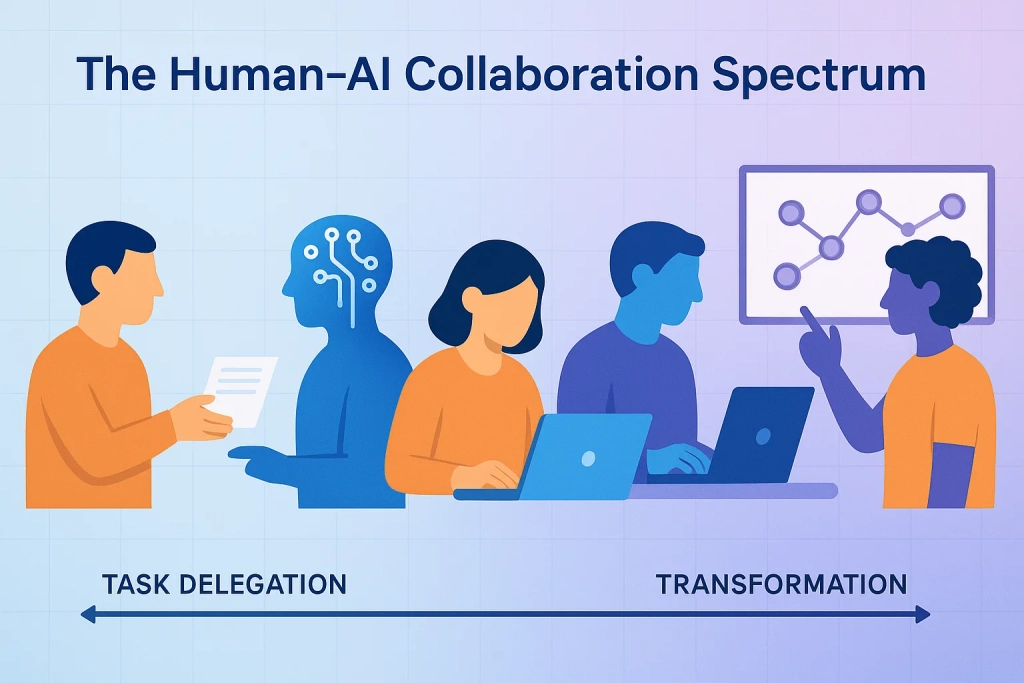
The Collaboration Spectrum: Finding Your Team’s Sweet Spot
As I’ve guided organizations through implementing human-AI marketing collaboration models, I’ve found that most teams exist somewhere on a spectrum rather than perfectly fitting one model. The key is identifying your optimal position based on:
- The nature of your marketing activities
- Your team’s technical capabilities
- Your competitive differentiation strategy
- Your organizational risk tolerance
For instance, when I worked with a financial services firm with strict compliance requirements, their human-AI marketing collaboration model heavily favored human oversight. AI generated options, but humans reviewed everything with multiple approval layers.
Conversely, a growth-stage e-commerce client I advised implemented human-AI marketing collaboration frameworks that pushed much more decision-making to AI systems, with humans focusing almost exclusively on strategy and creative direction.
Neither approach was wrong—they just reflected different organizational needs and constraints.
Model 3: The Transformation Framework - Reimagining Marketing Through Human-AI Collaboration
The most advanced human-AI marketing collaboration model I’ve implemented with clients is what I call the Transformation Framework. This isn’t just about making existing processes more efficient—it’s about fundamentally reimagining what’s possible when organizations build entirely new workflows around human-AI partnership.
Last summer, I worked with Nova Retail, a company that completely restructured their marketing department around a sophisticated human-AI marketing collaboration model. Instead of traditional roles like “content writer” or “social media manager,” they created integrated pods with humans and AI systems working as unified teams.
Each pod contained:
- A Strategic Director (human)
- Creative Navigator (human)
- Performance Analyst (human)
- AI Content System
- AI Analytics Engine
- AI Media Optimization System
The magical thing about this human-AI marketing collaboration model? It wasn’t just faster—it enabled entirely new marketing approaches. Their teams could simultaneously manage 40+ personalized customer journeys that would have been logistically impossible in a traditional structure.
God, I wish I’d had access to this framework back in my agency days! The nights I spent manually optimizing campaigns when an effective human-AI marketing collaboration model could have done it better and faster still haunts me.
The results for Nova were staggering: 215% increase in marketing-attributed revenue with just a 15% increase in department costs. That’s the power of transformation-level human-AI marketing collaboration frameworks.
Comparing Human-AI Marketing Collaboration Models: Finding Your Fit
| Aspect | Augmentation Framework | Integration Framework | Transformation Framework |
|---|---|---|---|
| AI’s Role | Task assistant | Collaborative partner | Co-strategist |
| Decision Authority | Primarily human | Shared with human oversight | Distributed based on strengths |
| Organization Structure | Traditional with AI support | Modified for collaboration | Rebuilt around AI capabilities |
| Skill Requirements | Basic AI literacy | Advanced AI orchestration | AI system design and governance |
| Implementation Complexity | Moderate | High | Very High |
| Potential Impact | 30-45% efficiency gain | 40-70% performance improvement | 100%+ capability expansion |
| Best For | Organizations beginning AI adoption | Teams with established AI literacy | Forward-thinking market leaders |
The most successful organizations I’ve worked with don’t jump immediately to the most advanced human-AI marketing collaboration models. They evolve deliberately, building capabilities and comfort at each stage.
My client Rebecca, a CMO at a mid-sized SaaS company, initially wanted to implement the Transformation Framework after hearing about its potential. After our readiness assessment, we decided to start with the Augmentation Framework instead. “I was disappointed at first,” she told me later, “but that foundation was absolutely necessary. We wouldn’t have succeeded with more advanced human-AI marketing collaboration models without mastering the basics first.”
Smart woman, that Rebecca.
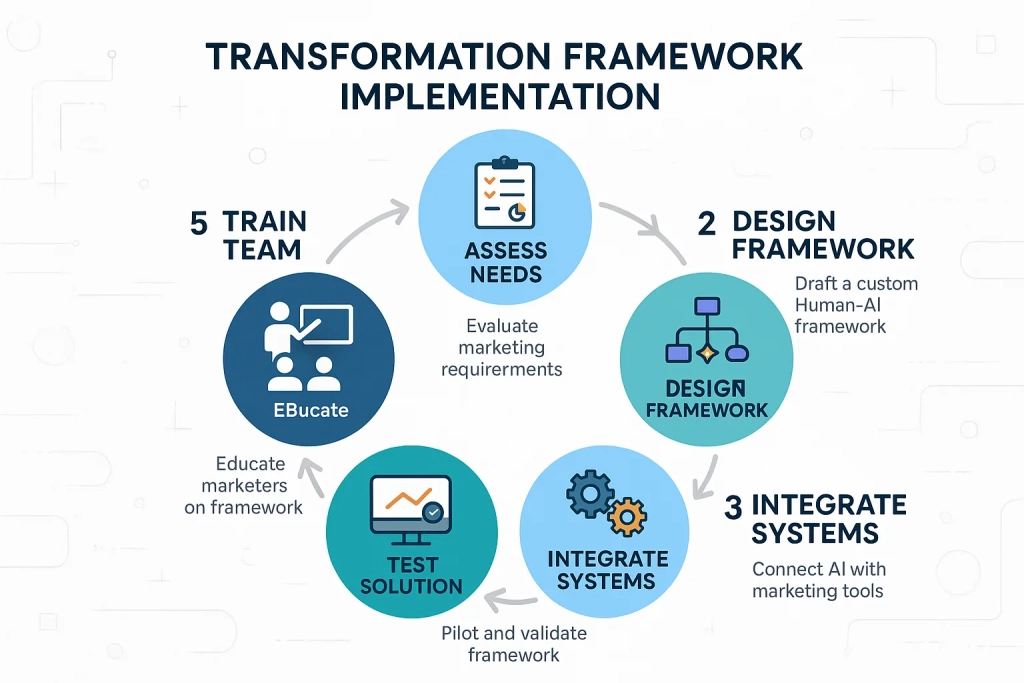
How to Develop Your Custom Human-AI Marketing Collaboration Framework in 5 Steps
After implementing human-AI marketing collaboration models across dozens of organizations, I’ve developed a reliable process for building custom frameworks:
- Audit and Map Current Workflows: Document exactly how work happens now, including decision points, handoffs, and bottlenecks.
- Conduct AI Opportunity Analysis: Evaluate each workflow component for AI augmentation, integration, or transformation potential.
- Design Collaboration Interfaces: Create clear protocols for how humans and AI will interact within each process.
- Develop Skills Enhancement Plan: Identify and address capability gaps through training and hiring.
- Implement Governance Systems: Establish oversight mechanisms to ensure quality, compliance, and continuous improvement.
When I implemented this process with DigitalFirst Agency, they discovered that their content production workflow had 14 steps—9 of which could be enhanced through human-AI marketing collaboration models. By redesigning these processes, they reduced content production time from 12 days to 3 days while maintaining (and in some cases improving) quality.
Just imagine what you could do with that kind of time back in your marketing operations.
My Hard-Learned Lessons About Human-AI Collaboration in Marketing Teams
I’d be doing you a disservice if I didn’t share some of the painful lessons I’ve learned implementing human-AI marketing collaboration models. Learn from my mistakes, please!
First, never underestimate resistance to change. When I implemented our first human-AI marketing collaboration model at TechForward, I assumed everyone would be excited about removing tedious tasks from their plates. I was wrong. Dead wrong.
Many team members saw AI as a threat rather than an ally. One senior copywriter, Mark (who later became one of our biggest AI champions), initially refused to use any AI tools. “You didn’t hire me to be a babysitter for robots,” he told me during one particularly heated meeting.
What worked? Involving skeptics like Mark in designing the human-AI marketing collaboration model rather than imposing it. When people help build the framework, they develop ownership and understanding that drives adoption.
Second, start with quick wins. The most successful human-AI marketing collaboration models I’ve implemented began with highly visible, low-risk processes where AI could demonstrate immediate value. Build confidence before tackling more complex or sensitive workflows.
And finally, measure obsessively. The organizations that get the most from their human-AI marketing collaboration models track both efficiency metrics (time saved, output increased) and effectiveness metrics (performance improvements, quality enhancements). Without this data, it’s impossible to refine your approach.
The Future of Human-AI Marketing Collaboration Models: Where We're Headed
As someone who’s been deep in this space for years, I believe we’re just scratching the surface of what’s possible with human-AI marketing collaboration models. Based on my work with leading organizations, here’s where I see this field evolving:
- Dynamic Collaboration Frameworks: Future human-AI marketing collaboration models will adaptively shift responsibilities between humans and AI based on real-time performance data.
- Cross-Functional AI Orchestration: AI systems will collaborate across traditionally siloed marketing functions, creating unprecedented coordination.
- Collective Intelligence Systems: Advanced human-AI marketing collaboration models will leverage the combined insights of multiple humans and AI systems to solve complex challenges.
One of my clients is already experimenting with a fascinating approach where their human-AI marketing collaboration model includes a “creative collective”—multiple specialized AI systems that collaborate with each other under human direction. The results are promising, with campaign concepts that neither humans nor individual AI systems would likely develop independently.
That’s the future I’m excited about—not AI replacing humans, but fundamentally new capabilities emerging from thoughtful human-AI marketing collaboration models.
Ready to Transform Your Marketing Team with Human-AI Collaboration?
If there’s one thing I’ve learned from implementing human-AI marketing collaboration models across dozens of organizations, it’s this: the competitive advantage doesn’t go to companies with the best AI tools. It goes to those with the best frameworks for human-AI collaboration.
The organizations thriving in this new era aren’t just adopting technology—they’re reimagining how humans and AI work together through thoughtful human-AI marketing collaboration models.
So, what’s your next step? Start by honestly assessing your organization’s current approach to AI. Are you simply delegating tasks, or building true collaboration? Have you developed organizational frameworks that maximize the unique strengths of both humans and AI?
I’m curious to hear about your experiences implementing human-AI marketing collaboration models in your organization. What’s working? Where are you struggling? Drop a comment below or reach out directly—I’m always looking for new perspectives on this rapidly evolving field.
Remember: The future belongs to marketers who build bridges, not barriers, between human creativity and AI capabilities.
Frequently Asked Questions About Human-AI Marketing Collaboration Models
1. How do I know which human-AI marketing collaboration model is right for my organization? Your optimal model depends on several factors: your team’s AI literacy, process maturity, strategic objectives, and risk tolerance. Most organizations should start with the Augmentation Framework to build foundational capabilities before progressing to more sophisticated human-AI marketing collaboration models.
2. Will implementing human-AI marketing collaboration models lead to staff reductions? In my experience working with over 30 companies, effective human-AI marketing collaboration models rarely result in headcount reduction. Instead, they enable teams to handle greater volume and complexity, often leading to role evolution rather than elimination.
3. What’s the biggest mistake organizations make when implementing human-AI collaboration frameworks? The most common pitfall I see is focusing exclusively on the technology while neglecting the organizational and cultural elements. Successful human-AI marketing collaboration models require clear governance, thoughtful process design, and change management—not just powerful AI tools.
4. How quickly can we expect to see results from implementing human-AI marketing collaboration models? Organizations typically see efficiency gains within the first 30-60 days of implementation. However, the more transformative benefits of advanced human-AI marketing collaboration models often emerge after 3-6 months as teams adapt to new workflows and capabilities mature.
5. Do effective human-AI marketing collaboration models require expensive technology investments? While some AI capabilities require significant investment, many organizations achieve substantial benefits from human-AI marketing collaboration models using relatively accessible tools. The organizational framework—how you structure collaboration—often matters more than having the most advanced technology.
6. How do we measure the success of our human-AI marketing collaboration model? Effective measurement combines efficiency metrics (time savings, increased output) with effectiveness metrics (performance improvements, quality enhancements) and transformation metrics (new capabilities, innovation indicators). The most successful organizations track all three dimensions.

