


After 15 years straddling the worlds of traditional finance and cutting-edge FinTech, I can tell you one thing with absolute certainty: that BBA Finance degree you’re clutching isn’t a barrier to FinTech success—it’s your secret weapon.
I remember sitting at my desk at Goldman Sachs back in 2011, watching as the first wave of financial technology companies began disrupting the industry I thought I understood. The panic was real. Would my finance background become irrelevant in this new tech-dominated landscape? Spoiler alert: it didn’t. Instead, it became my competitive advantage in a way I never expected.
Let me walk you through how to navigate the BBA Finance to FinTech transition without going back to school for a computer science degree. Because trust me, I learned this the hard way so you don’t have to.
Why Traditional Finance Graduates Are Actually Perfect for FinTech
When I first interviewed at a FinTech startup in 2013, I was terrified they’d ask me to code something on the spot. God, I hate those technical interviews that seem designed to humiliate anyone without a CS degree. But here’s what I discovered: while the tech guys could build amazing products, many couldn’t explain basic financial concepts like liquidity ratios or yield curves.
Your finance education gives you something incredibly valuable: deep domain knowledge. The successful BBA Finance to FinTech transition isn’t about becoming a coding wizard—it’s about being the translator between financial needs and technological solutions.
After managing teams with both finance and tech backgrounds, I’ve noticed finance graduates excel at:
- Understanding regulatory requirements (an absolute nightmare for pure tech folks)
- Identifying genuinely valuable use cases (not just cool tech demos)
- Speaking the language of potential financial institution clients
- Quantifying the actual business value of a solution
A former colleague with a CS degree once confessed to me, “I can build anything, but I have no idea WHAT we should build for banks.” That’s where you come in.
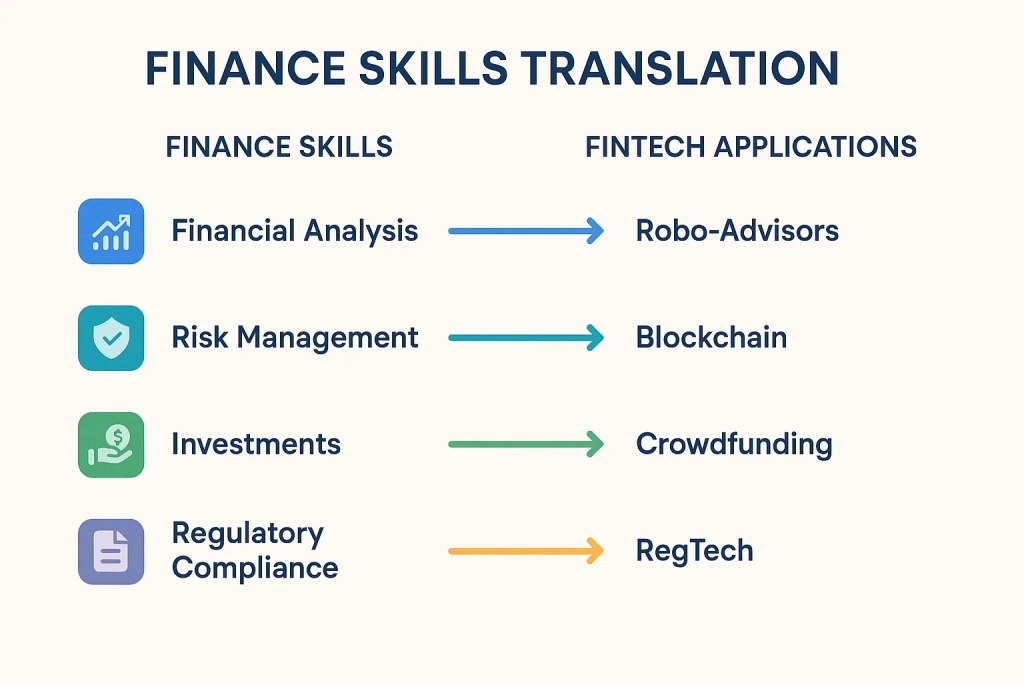
Identifying Your Transferable Skills for the FinTech Landscape
The BBA Finance to FinTech transition requires recognizing which of your existing skills are actually highly prized in this new environment. Last summer, I mentored a young finance graduate who was convinced she needed to learn Python before applying to FinTech companies. I told her to focus on leveraging what she already knew.
Your most valuable transferable skills include:
Financial Analysis & Risk Assessment
FinTech companies desperately need people who understand financial modeling, risk assessment, and compliance. When our startup was developing a new lending algorithm, it was the finance graduates who spotted potential regulatory issues that would have killed the product.
Client Relationship Management
Traditional finance teaches you how to manage relationships and understand client needs. Technical founders often struggle with this. I’ve watched brilliant developers create solutions that banks would never adopt because they didn’t understand how bank procurement processes work.
Product Development Insights
You understand what financial professionals and institutions actually need. That makes you invaluable for product development, even if you never write a line of code.
One time, our development team spent months building a feature our customers never used. Why? Because no one on the team had ever actually worked in finance. After that disaster, we made sure finance experts were involved from day one of any new project.
BBA Finance to FinTech Transition, BBA Finance to FinTech Transition, How to transorm the fintech in company, BBA Finance to FinTech Transition
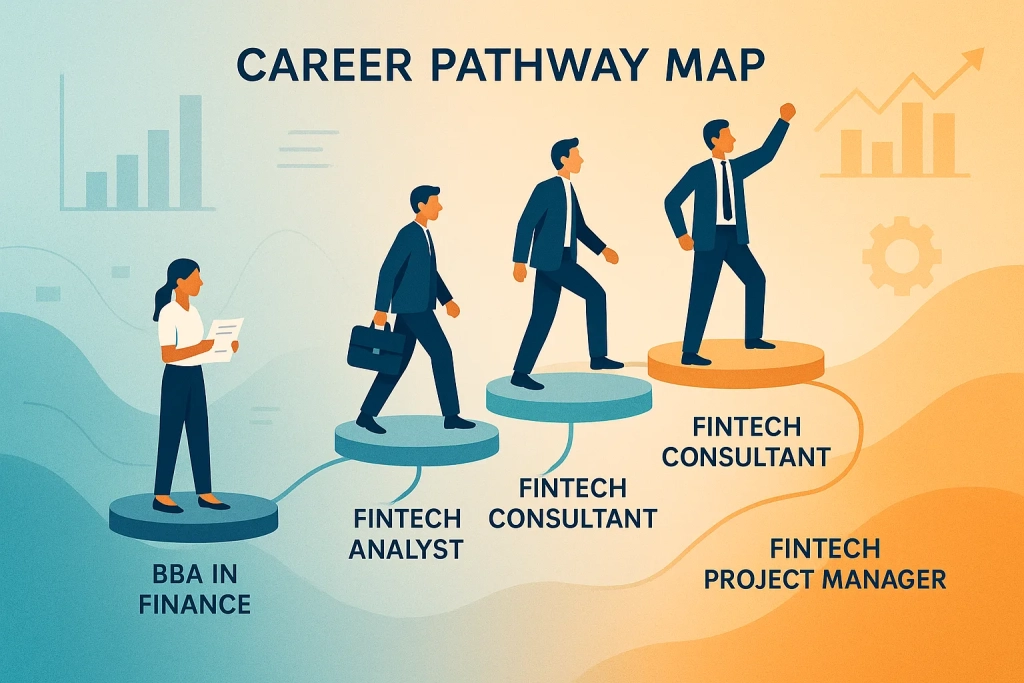
How to Position Yourself for the Finance-Tech Hybrid Role
1. Develop Tech Fluency (Not Necessarily Technical Skills)
There’s a big difference between tech fluency and technical skills. You don’t need to become a programmer, but you should understand the technology landscape and speak the language.
In my twenties, I spent weekends attending FinTech meetups where I felt completely out of place. But I forced myself to ask questions and learn the vocabulary. Within months, I could confidently discuss APIs, cloud infrastructure, and machine learning applications in finance—without knowing how to build any of it myself.
Start by:
- Taking a basic programming course to understand the logic (even if you never use it professionally)
- Reading tech blogs focused on financial applications
- Understanding common FinTech infrastructure and tools
- Learning what problems different technologies can solve
Remember when I mentioned a “tech fluency” rather than “tech skills”? Here’s a real example: I once helped my company select a blockchain solution for a trade finance product. I couldn’t code the blockchain, but I understood enough to ask critical questions about scalability, security, and compliance that the developers hadn’t considered
2. Leverage Your Financial Domain Expertise
Your deep understanding of financial processes, regulations, and client needs is your competitive edge. I’ve sat in countless job interviews where candidates with CS degrees couldn’t explain basic financial concepts like EBITDA or debt covenants.
Back in 2019, I hired a finance graduate over a computer science major for a product manager role because the finance graduate understood the pain points our banking clients faced. She could translate those needs to our development team in a way that created an actually useful product.
To highlight your domain expertise:
- Develop case studies around financial problems technology could solve
- Stay current on emerging financial regulations and their tech implications
- Build a point of view on how specific technologies can address financial challenges
- Network with both finance and tech professionals to understand both perspectives
3. Target Bridge Positions for Your First FinTech Role
The most successful finance skills for FinTech careers often start with bridge positions—roles that specifically leverage your financial background while exposing you to the tech side.
Look for positions like:
- Product Manager for financial products
- Business Analyst for FinTech projects
- Client Success Manager at FinTech companies
- Compliance Specialist focusing on FinTech
- Financial Analyst within a tech company
My first FinTech role was as a “Financial Product Specialist”—a fancy title that basically meant I helped the engineering team understand what financial features to build and why. It was perfect because I used my finance knowledge daily while learning the tech side through osmosis.
The Hybrid Skill Roadmap: Where Finance Meets Tech
If you’re serious about the BBA Finance to FinTech transition, you need a deliberate plan to develop hybrid skills. After mentoring countless finance graduates, here’s the roadmap I recommend:
Phase 1: Build Tech Awareness (3-6 months)
Start by immersing yourself in the tech world:
- Subscribe to FinTech newsletters and blogs
- Join FinTech communities (online and offline)
- Take introductory courses on technology concepts
- Attend FinTech webinars and conferences
During this phase, focus on understanding rather than doing. You’re building context and vocabulary.
Phase 2: Develop Bridge Skills (6-12 months)
Next, develop skills that connect finance and technology:
- Learn data analysis tools like Excel advanced functions, SQL basics, or Tableau
- Understand product development methodologies (Agile, Scrum)
- Study user experience principles for financial products
- Take project management courses
I once hired a finance graduate who had taught herself SQL basics. Not because she wanted to be a database administrator, but because she wanted to be able to pull her own data for financial analysis. That initiative showed me she understood where finance and tech intersect.
Phase 3: Apply Learning Through Projects (Ongoing)
Nothing demonstrates your hybrid value like actual projects:
- Volunteer for FinTech projects at your current company
- Create case studies analyzing FinTech companies
- Develop sample financial models that incorporate tech considerations
- Participate in FinTech hackathons (yes, even as a non-developer)
One of the most impressive candidates I ever interviewed had zero tech experience on her resume. But she had created a detailed analysis of how blockchain could reduce settlement times in securities trading, complete with process flows and financial impact models. That project got her the job over candidates with far more technical backgrounds.
BBA Finance to FinTech Transition, BBA Finance to FinTech Transition, How to transorm the fintech in company, BBA Finance to FinTech Transition
Breaking into FinTech: Non-Technical Roles with High Impact
There are numerous non-technical FinTech job opportunities where finance graduates can thrive. These roles often pay just as well as technical positions and can have even greater strategic impact.
Product Management
As a Product Manager in FinTech, you become the bridge between business needs and technical solutions. You don’t need to code, but you need to understand both financial requirements and technical constraints.
I transitioned to product management seven years into my career, and it completely transformed my trajectory. I was suddenly valued precisely because I understood financial processes deeply but could translate them into product features.
Business Development
FinTech companies desperately need people who can speak the language of financial institutions. My friend Sarah, another BBA Finance graduate, became one of the highest-paid employees at her FinTech startup specifically because she could get meetings with banks and actually understand their problems.
Strategy and Operations
Operations roles in FinTech require understanding both process efficiency and financial implications—perfect for finance graduates. A former colleague went from financial analyst at JPMorgan to Operations Director at a payments startup within three years, doubling his salary in the process.
Risk and Compliance
As FinTech has matured, risk and compliance roles have become critical. Finance graduates who understand regulatory requirements are perfectly positioned for these high-demand roles.
Trust me, I learned this the hard way when our startup nearly got shut down because we didn’t have anyone focusing on regulatory compliance until it was almost too late.
The Tech-Finance Hybrid: Comparative Advantage
Let me break down exactly how finance graduates in technology sector can position themselves compared to both traditional finance professionals and technical experts:
| Skill Area | Traditional Finance | Technical Expert | Finance-Tech Hybrid |
|---|---|---|---|
| Technical Development | Limited | Strong | Basic understanding |
| Financial Domain Knowledge | Strong | Limited | Strong |
| Regulatory Understanding | Strong | Minimal | Strong |
| Product Vision | Process-focused | Technology-focused | Solution-focused |
| Client Relationship | Strong | Variable | Strong |
| Growth Potential | Industry-constrained | Role-constrained | Cross-functional |
As someone who’s hired for all three categories, I can tell you that the Finance-Tech Hybrid often becomes the most valuable team member because they can translate between departments and see the big picture.
BBA Finance to FinTech Transition, BBA Finance to FinTech Transition, How to transorm the fintech in company, BBA Finance to FinTech Transition, BBA Finance to FinTech Transition, BBA Finance to FinTech Transition, BBA Finance to FinTech Transition
Real Talk: Challenges in Making the BBA Finance to FinTech Transition
Let’s be honest—this transition isn’t always smooth. During my own journey, I faced plenty of obstacles:
Imposter Syndrome
I still remember my first week at a FinTech startup, surrounded by engineers discussing programming languages. I felt like a complete fraud. Months later, one of those same engineers confessed he felt equally intimidated discussing financial concepts with me. Perspective is everything.
Learning Curve
The learning curve can be steep. For my first six months in FinTech, I spent every weekend studying tech concepts just to keep up with Monday morning meetings. It was exhausting but worth it.
Cultural Differences
Banking and FinTech cultures are dramatically different. I went from a bank where decisions took months to a startup where we deployed code changes daily. That adjustment was actually harder than learning the technical concepts.
How to Market Yourself for FinTech Success
Successfully marketing yourself for the BBA Finance to FinTech transition requires a specific approach:
Resume Positioning
Reframe your finance experience in terms of problems solved, not just responsibilities held. Instead of “Conducted financial analysis,” try “Identified $2M in potential savings by analyzing cost structures and recommending automation opportunities.”
Interview Strategies
In interviews, proactively address the tech question. I always open with something like: “While my background is in finance, I’ve developed a strong understanding of how technology can solve financial problems, specifically in areas like…”
Networking Approaches
Target people in bridge roles for informational interviews. They’ve already made the transition you’re attempting and can provide specific guidance.
Back in 2017, I reached out to 20 people with finance backgrounds working at FinTech companies. The seven who responded gave me invaluable advice that directly led to my role at a payments startup.
The Future Belongs to Hybrids
The finance industry is never going back to its pre-tech state. But neither is technology going to completely eliminate the need for financial expertise. The future belongs to hybrids who can navigate both worlds.
The most successful BBA Finance to FinTech transition stories I’ve witnessed share a common thread: these professionals didn’t try to become something they’re not (suddenly technical experts). Instead, they positioned their existing knowledge as complementary to technology, not in competition with it.
One piece of advice I give everyone attempting this transition: Think of yourself as a translator, not a converter. Your job isn’t to become a programmer—it’s to bridge worlds that desperately need connection.
Your Next Steps Toward FinTech
If you’re ready to make the BBA Finance to FinTech transition, here’s what to do tomorrow:
- Audit your LinkedIn profile to emphasize problem-solving and results, not just financial expertise
- Register for one FinTech webinar or online course this week
- Identify three companies making the specific type of finance-tech hybrid transitions that interest you
- Reach out to one person at each company who made a similar transition from finance
- Start building your “bridge skills” learning plan
Remember, your finance background isn’t something to overcome—it’s your competitive advantage in a world where anyone can learn to code, but few truly understand finance.
I made this transition with nothing but a BBA in Finance and a determination to stay relevant in a changing industry. If I could do it during the first wave of FinTech disruption, you can absolutely do it now with far more resources and examples to follow.
The bridge between finance and technology isn’t just a career path—it’s where the most interesting problems in our industry are being solved. And that’s exactly where you want to be.
FAQs About the BBA Finance to FinTech Transition
Do I need to learn programming languages to work in FinTech?
Not necessarily. While technical fluency is valuable, many crucial roles require financial expertise rather than coding skills. Understanding basic programming concepts can help you communicate with technical teams, but you don’t need to become a developer.
What entry-level roles should finance graduates target in FinTech?
Look for roles like Financial Analyst, Business Analyst, Customer Success Specialist, or Operations Associate at FinTech companies. These positions often value your financial knowledge while exposing you to the technology side.
How important is networking for breaking into FinTech?
Extremely important. The finance-to-FinTech path often isn’t straightforward, so connections can help you identify opportunities that might not be obvious. Target professionals who have made similar transitions for the most relevant advice.
Will my lack of technical degree be a major disadvantage?
Not if you position yourself correctly. Many FinTech companies actually prefer candidates with strong financial domain expertise for non-engineering roles. Your BBA in Finance provides valuable knowledge that many technical employees lack.
Should I get additional certifications before applying to FinTech roles?
Targeted certifications can help, but focus on those that build bridge skills rather than purely technical credentials. Project management certifications, data analysis courses, or FinTech-specific programs often provide more value than general technical certifications.
How does the compensation in FinTech compare to traditional finance roles?
FinTech compensation is often competitive with or higher than traditional finance, especially as you progress. Early-stage startups might offer lower base salaries but include equity compensation with significant upside potential. More established FinTech companies typically offer compensation packages comparable to traditional financial institutions.

