


Have you ever sat in a quantitative finance class feeling like everyone else was speaking a language you never learned? I’ve been there. Actually, I spent most of my BBA program there—drowning in formulas while wondering if I’d made a terrible career choice. But here’s the thing: fifteen years and a successful finance career later, I can tell you that quantitative finance for business students doesn’t have to be the nightmare many of us make it out to be.
When I was 19, I literally hid in a bathroom stall before my first financial mathematics midterm. Not my proudest moment. But that terrified student eventually became someone who uses quantitative models daily and (shockingly) enjoys it. This transformation wasn’t because I suddenly became a math genius—trust me, I didn’t—but because I developed strategic approaches that worked for my business-oriented brain.
Why Business Students Often Struggle with the "Quant" in Finance
Let’s address the elephant in the room: many of us chose business degrees partly to avoid heavy mathematics. I remember telling my advisor, “I want to work with people and strategy, not just numbers.” She smiled knowingly—she’d heard it a thousand times before.
The reality? Quantitative finance for business students has become increasingly unavoidable as the financial world grows more complex. When I started at Goldman Sachs in 2011, even entry-level analysts needed to understand basic modeling concepts. Today, the bar is even higher.
According to a 2023 survey by the Financial Management Association, 78% of employers expect business graduates to demonstrate competence in quantitative analysis—even for roles that aren’t explicitly quantitative. God, I wish someone had told me that when I was trying to coast through my statistics classes!
The Psychology Behind Math Anxiety in Business Students
Before we dive into strategies, let’s understand what’s actually happening when you feel that panic rising during a quant finance lecture.
Math anxiety isn’t just “being bad at math.” Research from Stanford’s Mathematics Education Center shows it’s a genuine psychological response that triggers the same brain regions as physical pain. When facing quantitative finance for business students courses, this anxiety creates a self-reinforcing cycle:
- You encounter a challenging concept
- Anxiety triggers a stress response
- Working memory becomes impaired
- Learning capacity diminishes
- Performance suffers
- Your belief that “I can’t do math” strengthens
I spent three years in this cycle. My breaking point? Failing a derivatives pricing exam so badly that my professor actually called me into his office. “Jamie,” he said, “you’re articulate and insightful in discussions, but your quantitative work shows none of that intelligence.” Ouch.
Shifting Your Mindset: Quantitative Finance Is Business Storytelling
The first breakthrough in my relationship with quantitative finance for business students came when a TA explained something that changed everything: “Finance math isn’t about the equations—it’s about the stories those equations tell about business.”
This perspective shift was revolutionary for me. When I stopped seeing formulas as abstract puzzles and started seeing them as tools that explained business realities, things began clicking.
Practical Strategy 1: Connect Every Equation to a Business Decision
When tackling practical quantitative finance strategies, start by asking: “What business question does this formula answer?”
For example, when I was struggling with Capital Asset Pricing Model (CAPM), I reframed it:
- Traditional approach: “Calculate expected return using risk-free rate plus beta times market risk premium”
- My business-brain translation: “How much extra return should investors demand for taking on this specific risk compared to safer options?”
This simple shift helped me move from memorization to understanding. Suddenly, beta wasn’t just a Greek symbol—it was a measurement of how wild a stock’s price might swing compared to the overall market. That’s something my business brain could grasp!
The BBA Student’s Toolkit for Quantitative Finance Success
Over my years helping other math-anxious business students (and honestly, colleagues too), I’ve developed a practical toolkit for mastering quantitative finance for business students without the typical anxiety spiral.

Strategy 2: Build Your Quantitative Vocabulary Gradually
Finance has its own mathematical language. Rather than trying to become fluent overnight, build your vocabulary term by term.
When I was a junior analyst, I kept a small notebook where I wrote down one new quantitative concept each day, explained in my own words. By the end of my first year, I had over 200 entries—and a surprisingly solid foundation that I still reference today.
For example, my entry on “standard deviation” wasn’t the textbook definition but: “The measurement of how much people are freaking out about a stock—higher number means more drama.”
This BBA student guide to financial mathematics approach works because it respects how our brains actually learn—incrementally and through personal connection.
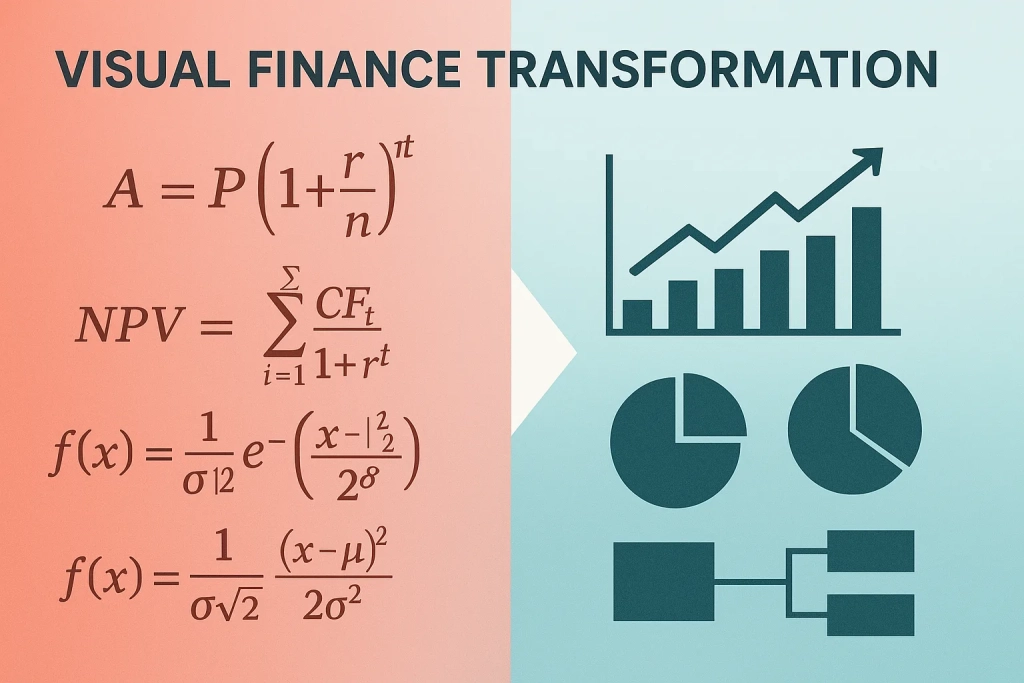
Strategy 3: Visualize Before You Calculate
One technique that revolutionized my approach to quantitative finance for business students was drawing concepts before calculating them.
Last summer, I was helping my niece with her finance homework, and I realized I was using the same technique I’d developed in college. Before diving into Black-Scholes option pricing calculations, we drew out what an option actually does—with little stick figures buying and selling rights to purchase stocks at certain prices.
Studies from the Journal of Educational Psychology confirm this works: visual representations activate different neural pathways than symbolic mathematics, giving your brain multiple ways to process the same information. For those overcoming math anxiety in finance courses, this dual-coding approach creates a safety net for your learning.
The Technology Advantage: Tools for the Math-Anxious
Back in my twenties (circa 2008), we were still expected to work through many calculations by hand. Today’s quantitative finance for business students have incredible technological advantages—use them without shame!
Strategy 4: Use Technology as Training Wheels, Not Crutches
When I work with interns struggling with quantitative finance for business students concepts, I recommend a gradual approach with technology:
- Use Excel/software to solve the complete problem
- Break down what each formula component does
- Alter input variables to see how outputs change
- Only then attempt manual calculations
For example, when tackling time value of money problems, try using a financial calculator app first. Play with different inputs to develop intuition for how changes affect outcomes. This builds confidence before diving into the formulas.
I learned this approach the hard way. In my valuation class, I tried memorizing DCF formulas without understanding them and bombed the midterm. For the final, I spent hours playing with spreadsheet models, changing variables and observing effects. The result? A 94% and a technique I still use when approaching new practical quantitative finance strategies.
The Comparison Trap: Your Finance Journey Is Your Own
One thing that intensified my math anxiety was constantly comparing myself to classmates who seemed to grasp concepts effortlessly. Let me share something I wish I’d known earlier: many of them were struggling too, just differently or privately.
Strategy 5: Build Your Personal Finance Learning Network
One of the most effective practical quantitative finance strategies I developed was creating a diverse study group:
| Group Member Type | Their Strength | What You Gain |
|---|---|---|
| The Natural Quant | Intuitive grasp of formulas | Translation of concepts into clearer terms |
| The Business Contextualizer | Connecting math to real scenarios | Practical applications that make formulas meaningful |
| The Process Person | Systematic problem-solving | Step-by-step approaches to complex problems |
| The Questioner (possibly you!) | Identifying confusion points | Permission to seek clarity where others might not |
In my senior year, our finance study group had exactly this mix. Carlos (our quant genius) would solve problems quickly, but Maria would always ask, “But what does this mean for the business decision?” Their complementary perspectives helped me build a complete understanding that neither could provide alone.
From Classroom to Career: Quantitative Skills in the Real World
After seven years at investment banks and three at a fintech startup, I can tell you that quantitative finance for business students pays dividends throughout your career—even if you never become a quant analyst.
How Quantitative Thinking Helps Business Professionals
In 2019, I was in a strategy meeting where our team was discussing a potential acquisition. The dealmakers were excited about the target company’s growth numbers, but something felt off to me. Because of my quantitative training, I could quickly calculate that their compound annual growth rate was mathematically implausible given their market’s saturation. This simple insight—which came from basic exponential growth understanding—saved us from a potentially disastrous acquisition.
For business students overcoming math anxiety in finance courses, remember that your goal isn’t becoming a human calculator. It’s developing the quantitative literacy to:
- Understand what the numbers are telling you
- Identify when numbers don’t tell the complete story
- Ask intelligent questions about quantitative conclusions
- Know when to trust or question financial models
My Three-Week Plan for Conquering Any Quantitative Finance Course
If you’re currently struggling with a quantitative finance for business students course, here’s my battle-tested three-week plan for getting back on track:
Week 1: Foundation Building
- Day 1-2: Identify and list all key formulas/concepts
- Day 3-5: Create simple, non-mathematical explanations for each
- Weekend: Find real company examples for key concepts
Week 2: Structured Practice
- Day 1-3: Solve basic problems with technology assistance
- Day 4-5: Attempt problems with partial technology help
- Weekend: Test yourself with varied problem types
Week 3: Integration and Application
- Day 1-2: Connect concepts to each other
- Day 3-5: Apply concepts to a mini case study
- Weekend: Teach concepts to someone else (the ultimate test!)
I used this exact approach when preparing for my Series 7 exam, which includes surprisingly challenging quantitative components. Despite my lingering math anxiety, I passed on my first attempt—something only about 65% of candidates manage.
Moving Beyond Formulas: The Human Side of Quantitative Finance
The most valuable lesson I’ve learned in my journey with quantitative finance for business students is that the most sophisticated models still require human judgment. This is where business students often have an advantage over pure mathematics majors.
In 2021, I worked with a brilliant quant who had built a statistically perfect trading algorithm. On paper, it was flawless. But it failed to account for how news events triggered human panic reactions that defied mathematical prediction. My business training helped identify this blind spot and improve the model.
For students focused on overcoming math anxiety in finance courses, this perspective is comforting. Your “softer” business insights are just as valuable as quantitative precision—you need both.
Final Thoughts: Embracing Quantitative Finance as a Business Strength
Looking back at my journey from math-phobic BBA student to confident financial professional, the transformation in how I approach quantitative finance for business students has been profound. The panic and dread have been replaced by curiosity and even enjoyment.
I won’t pretend I’ve become a mathematical prodigy—I definitely haven’t. Just last week I still had to Google “how to calculate weighted average cost of capital” to double-check my work. But the difference is that now these concepts feel like useful tools rather than insurmountable obstacles.
Remember: quantitative finance for business students isn’t about becoming a human calculator. It’s about developing enough confidence and competence to use quantitative insights to make better business decisions. And trust me—if I could make that journey from the bathroom stall of terror to financial analysis confidence, you absolutely can too.
Would love to hear about your own experiences with quantitative finance courses! Drop a comment below or reach out if you’re currently in the struggle—I’m always happy to share more specific strategies that might help your particular situation.
FAQ: Quantitative Finance for Business Students
Q1: Do I need to be “good at math” to succeed in quantitative finance courses?
No, you need to be good at approaching problems systematically and connecting mathematics to business contexts. Many successful finance professionals weren’t naturally gifted at math but developed strategic approaches to quantitative concepts.
Q2: Which quantitative finance concept do business students struggle with most?
In my experience teaching and mentoring, option pricing models and stochastic calculus concepts create the most anxiety. These areas combine multiple mathematical disciplines and often require visualization techniques to fully grasp.
Q3: How much programming knowledge do I need for quantitative finance courses?
For most BBA programs, basic Excel proficiency is sufficient. However, familiarity with either Python or R is becoming increasingly valuable, especially for those interested in investment banking or financial analysis careers.
Q4: Can I use calculators/software during quantitative finance exams?
This varies by professor and program. Most allow basic financial calculators, but the trend is moving toward understanding concepts rather than memorizing formulas. Check your specific course policies and prepare accordingly.
Q5: How do I know if I should pursue more quantitative finance electives despite my anxiety?
Consider your career goals. If you’re interested in investment banking, financial analysis, or corporate finance roles, additional quantitative courses will be valuable despite the challenge. The key is finding courses taught with business applications emphasized over pure theory.
Q6: What’s the single most effective way to study for quantitative finance exams?
Teaching concepts to others forces you to translate mathematical ideas into clear language. Form a study group where you take turns explaining concepts, or offer to tutor classmates who are struggling even more than you are—this will solidify your own understanding.

